What Scandinavian style means in custom furniture: light wood, simple forms and clever hidden storage. Key features, materials, colours and common mistakes.
Scandinavian style means light, natural wood and a sense of order where every object has its place. In custom furniture it translates into pale fronts, hidden storage systems and simple forms that handle daily use well.
What Scandinavian style is
Scandinavian style was born in the Nordic countries – Sweden, Denmark, Norway and Finland – in the first half of the 20th century, reaching its mature form in the 1950s and 60s. Its roots lie in a simple geographical fact: winters are long and daylight is scarce. Interiors were therefore designed to make the most of every ray of sun and to avoid overwhelming their occupants during the months when the day lasts only a few hours.
The second pillar was the idea of democratic design – furniture that is well designed, durable and available to ordinary people, not only to elites. Form was meant to follow function rather than ornament. From this principle came clean lines, legible proportions and materials that age with dignity. Furniture was meant to serve for years rather than go out of fashion each season, and it is precisely this durability, both physical and aesthetic, that carried the style far beyond northern Europe.
Over time two words entered the vocabulary that capture the spirit of the style well. The Danish hygge is a feeling of warmth, closeness and safety in one's own home. The Swedish lagom means "just right" – neither too much nor too little. Together they describe an interior that is calm, orderly and friendly, not austere. This distinction matters, because Scandinavian minimalism was never cold or empty – it was about rejecting excess, not giving up cosiness.
It is worth distinguishing Scandinavian style from pure minimalism. Both avoid excess, but the Scandinavian approach emphasises warmth, naturalness and comfort, while minimalism tends to be more rigorous and cool. It is exactly this accessibility – bright, friendly interiors that do not require expensive, showy furniture – that made the style one of the most popular in the world. It also fits Polish flats well, where both floor space and sunlight are often in short supply and the need for a practical, orderly interior is especially strong.
Key features of Scandinavian style
You will recognise a Scandinavian interior by a few recurring principles. It is not about a single piece of furniture, but about a coherent approach to the whole space.
- A light palette as background. White, greys and beiges reflect light and visually enlarge the room.
- Natural wood. Most often in pale shades, shown as a decorative element rather than merely a structural one.
- Function before ornament. Every element has a task; decoration is sparse and deliberate.
- A simple, legible form. Geometry instead of detail, smooth fronts instead of profiles.
- Hidden storage. Order comes from things having somewhere to disappear.
- Soft textiles and plants. Wool, linen and greenery add the warmth that wood alone cannot.
Balance between warm and cool also matters. A light background can feel cold, so it is balanced with warm wood, natural fabrics and light of a pleasant tone. That is why a well-designed Scandinavian interior does not look like a sterile studio, but like a place you want to stay in. Artificial light counts too – instead of a single strong source, several diffuse, warm points are used, building atmosphere in the evening and emphasising the grain of the wood.
The attitude to space is also characteristic. Scandinavians value "breathing room" around furniture – free floor, exposed walls, no clutter. As a result even a small flat feels larger and the eye has somewhere to rest. This visual calm is just as important as the specific materials.
Materials and colours
Wood and its light shades are the foundation. Most often you will meet oak, birch, ash and pine – chosen for a legible grain and a warm, natural tone. In custom furniture wood can be a solid front, a veneer or a decor that imitates the structure well. The finish is key: matte or satin, because high gloss does not suit this aesthetic.
The colour palette is built in layers. Whites, greys and beiges form the background, complemented by muted accents: sage green, subdued blue, graphite or black used pointwise. Strong, saturated colours appear rarely, and rather in accessories than in the furniture itself. As a result the interior stays calm even after years, when only the textiles and small objects change.
Texture is as important here as colour. Matte fronts, the natural structure of wood, linen, wool and ceramics mean that even a very light interior has depth and does not look flat. It is precisely this play of textures that saves the Scandinavian style from a sense of emptiness. In kitchen units a combination of light fronts with a worktop of visible grain works well, and in the living room – smooth cabinets broken up by an open shelf of natural wood. Metals, if they appear, are rather matte and discreet, so as not to compete with the natural materials.
Increasingly, attention is also paid to the origin and durability of materials. Natural wood, solid finishes and good hardware are not only a matter of aesthetics but of an approach in which furniture is bought once rather than replaced every few years. This philosophy – less, but better – has been part of Scandinavian thinking about the home from the very beginning, and it explains well why it is worth investing in the quality of the build rather than saving on the material.
Who Scandinavian style suits
This style works particularly well in flats with limited floor space and a shortage of light – a light palette and order do the most good here. It will be appreciated by people who like an orderly space without visual excess, and by families who care about furniture that is simple to maintain and resistant to daily use.
Scandinavia is also a good choice for those who plan to live in one interior for a long time. A calm base easily withstands changes in fashion – it is enough to replace the accessories rather than the whole fit-out. This is a real saving in the longer term: the furniture stays current, and refreshing the interior costs about as much as new textiles or a lamp. If you are furnishing a house or flat, it is worth seeing how this style works in practice in our projects for the home.
The style also combines well with other directions – with a hint of industrial, with natural materials in the spirit of japandi, or with single vintage elements. Thanks to the calm base, such combinations do not look chaotic, which gives a lot of freedom in arrangement and lets you give the interior an individual character without giving up order. This is good news for those who fear that Scandinavian simplicity will turn out boring – a single expressive accent is enough to give the whole thing character.
How to introduce the style in custom furniture
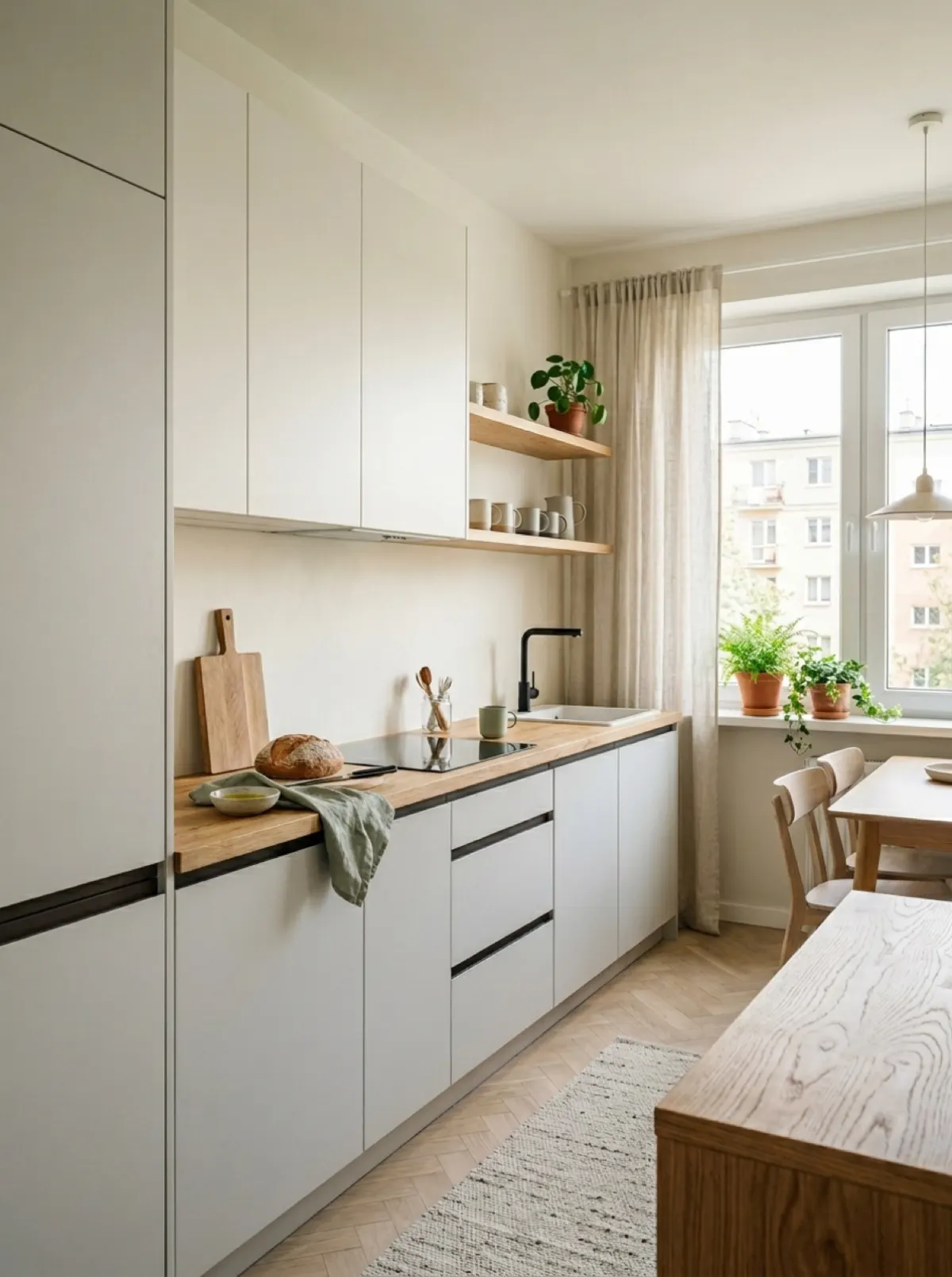
Custom furniture is the most convenient route to this style, because it lets you reconcile a light, simple aesthetic with real order. In the kitchen, smooth matte fronts without handles, or with discreet straight handles, work well. A combination of light units with a wooden worktop or open wooden shelves, which warm up the interior, works nicely.
In walk-in wardrobes and built-in closets the key is what you cannot see: a thoughtful division of the interior, with drawers, shelves and rails matched to what you actually store. Scandinavian order does not come from a minimal number of things, but from each having its place. That is why floor-to-ceiling builds and handleless fronts are common solutions – they hide the contents and keep a calm, continuous plane.
In the living room and bedroom the emphasis is on low, simple forms, builds around the television without an excess of elements, and the interiors of chests and cabinets planned so that mess can be quickly hidden. In the hallway this style solves a typical small-space problem: a floor-to-ceiling wardrobe with room for shoes, outerwear and odds and ends keeps the entrance clean and bright. Even in a bathroom or a child's room the same logic – light fronts, hidden storage, a simple form – orders the space without introducing a chaos of colours.
The same language also works in workspaces – light, orderly furniture works well in offices and premises, where a calm background helps concentration, as you can see in our projects for business. For inspiration it is also worth looking at the portfolio, to see how the same principles look across different floor areas.
In custom furniture it is also easy to plan lighting, which is key for this style. Lighting under kitchen cabinets, light strips in the wardrobe or gentle light in the recesses of shelving not only make daily tasks easier but also build the warm mood that a light palette does not give on its own. Kitchen appliances are most often hidden behind fronts to maintain a calm, uniform plane, and sockets and connections are planned in advance so that they do not disturb the clean line of the build.
The most common mistakes
The first mistake is confusing the Scandinavian style with sterility. White alone, without textures and wood, gives the impression of a waiting room rather than a home. The remedy is layering materials: matte fronts, natural wood, linen and wool, plus warm light in the evening.
The second mistake is saving on the finish. Cheap gloss, visible mismatched edges and uneven fronts spoil the effect immediately, because in such a simple form every detail is visible. In this style the quality of execution counts more than the number of elements – there is no ornament behind which to hide flaws.
The third mistake is disregarding light and mixing too many species of wood at once. A light palette only works when the interior is well lit, and it is worth limiting the various shades of wood to one, at most two, so that the whole remains coherent. The fourth common problem is the lack of thoughtful storage – without it the order on which this style relies is impossible to maintain, and open shelves quickly turn into a place where small things accumulate. The fifth mistake, less obvious, is overdoing it in the other direction: following the rules so rigorously that the interior becomes impersonal. Scandinavian style tolerates, and even likes, one personal accent – a picture, a plant, an expressive fabric – which gives the space character and distinguishes a home from a catalogue arrangement.
How we do it at Grandis
We have designed and produced custom furniture for more than 15 years, in our own 3 000 m² workshop. We have over 300 completed projects behind us – from flats to commercial spaces – so we plan Scandinavian order not on a photograph, but around real dimensions and a way of life.
We start every project with a laser measurement and a 3D visualisation, which is included in the price – before production you already see how the light fronts and divisions will play in your interior. We work with European-class materials and certified hardware, and installation is carried out by our in-house team, not subcontractors. A standard project takes 2–4 weeks, and we set the price as fixed, with no annexes along the way. This way the form, simple by design, keeps the quality of execution that, in this style, decides everything.
A calm, light interior is not a question of the number of pieces of furniture, but of well-planned storage and a clean form.
Frequently asked questions
Does Scandinavian style work in a small flat?
Yes, it is one of the best choices for small floor areas. A light palette and simple fronts visually enlarge the interior, and custom furniture lets you use every centimetre, including floor-to-ceiling builds and difficult spots such as slopes or recesses.
Which wood suits this style best?
Most often pale species with a legible grain are chosen, such as oak, birch, ash or pine, in a matte or satin finish. More important than the species itself, however, is limiting the number of wood shades in the interior so that the whole remains coherent.
Is light furniture practical day to day?
Yes, provided the finish is good. Matte, smooth fronts and certified hardware are resistant to daily use and easy to maintain. Handleless fronts additionally reduce the places where dirt collects.
How long does a custom build take?
Typically 2 to 4 weeks from approval of the project, depending on the scope. We begin the whole process with a laser measurement and a 3D design included in the price, and we set the price as fixed.
How does Scandinavian style differ from minimalism?
Both styles avoid excess, but the Scandinavian one is warmer and cosier – it relies on natural wood, textiles and soft light, while minimalism tends to be more severe and rigorous in form. In practice a Scandinavian interior is easier to live with day to day, because it does not require maintaining a perfect emptiness.