What minimalist style means in custom furniture: handleless fronts, clean planes and hidden storage. Key features, materials, colours and common mistakes here.
Minimalism is deliberate reduction: only what is needed, in the purest possible form. In custom furniture it means handleless fronts, continuous planes and all the storage hidden so that the space can breathe.
What minimalist style is
Minimalism as a direction in design took shape in the second half of the 20th century, drawing on modernism, minimal art and Japanese aesthetics. Its essence is not emptiness for its own sake, but the principle of "less, but better" – limiting things to those genuinely needed and executing them to the highest level. What remains is meant to be refined in every detail.
In practice minimalism is a constant game of subtraction. Superfluous divisions, ornaments, handles and everything that distracts the eye are removed. As a result attention shifts to proportions, the quality of the material and light. A minimalist interior does not shout – it works through calm and order, and its strength lies in what you cannot see.
It is worth distinguishing minimalism from Scandinavian and modern styles. The Scandinavian one is warmer and cosier, the modern one reaches more readily for contrasts and technology. Minimalism is the most rigorous: it strives for maximum purity of form, even at the cost of giving up some decorative elements. It is a demanding style in which nothing can be hidden behind ornament.
Minimalism was strongly influenced by Japanese aesthetics, in which emptiness and simplicity are a value in themselves, and beauty is often seen in modest, natural things. Hence the attention paid in a minimalist interior to proportions, natural materials and calm. It is also worth remembering that minimalism is not a passing fashion but a mature design philosophy – consistent and demanding, but for that reason exceptionally durable over time. An interior designed in its spirit does not grow boring or lose relevance, because it does not rely on fashionable accessories but on the timeless principle of limiting things to what is essential.
Key features of minimalist style
You will recognise a minimalist interior by a consistent limitation of means and care for every plane.
- Handleless, smooth fronts. Touch-opening, with no protruding elements.
- Monolithic, continuous planes. As few visible divisions and joints as possible.
- Hidden storage. All the contents disappear behind uniform fronts.
- A limited, calm palette. Most often one or two colours in different shades.
- No decoration. The role of ornament is taken over by the texture of the material and light.
- A refined detail. Perfect gaps, even edges, precise fit.
The most important feature of minimalism is that order is a condition here, not a result. Since there are no ornaments or many colours, any object left out immediately catches the eye. That is why a minimalist interior must have a planned place for absolutely everything – only then does it look the way it should.
The second important feature is the significance of light and proportions. When decoration disappears from an interior, it is the division of planes, the play of shadow on a matte front and natural light that build character. In well-designed minimalism an empty wall or smooth cabinetry are not boring – they are a deliberate background that calms.
Materials and colours
In minimalism the material plays first fiddle, because there is nothing to draw attention away from it. Smooth boards in matte finishes, lacquered fronts, uniform surfaces imitating stone and large formats that limit the number of joints are used. Wood appears sparingly, in the role of a warm, natural accent against a background of white or grey.
The palette is reduced to the maximum. Most often it is one colour in several shades – whites, greys, beiges, sometimes deep black or graphite. Contrast tends to be subtle: a lighter front set against a darker worktop, warm beige with cool grey. Strong colours are a rarity here, because any excess breaks the calm of the whole.
Since there is no decoration, texture and the quality of the finish take on enormous importance. A matte, silky board, the natural grain of stone, a smooth surface without gloss – these create depth. That is why in minimalism it does not pay to save on the material: a cheap front or an uneven edge immediately spoils the impression of cleanliness on which the whole style rests.
In minimalism it is worth treating light and space as full-fledged materials. Natural light from the window, soft indirect light in the evening and the "breathing room" of a free wall or floor build the character of an interior as strongly as a particular board or stone. That is why well-designed minimalism is not about removing everything, but about leaving exactly as much as is needed and surrounding it with space. An empty plane is not a lack here but a deliberate decision – a background that calms and lets the few, carefully chosen elements stand out. This ability to work with emptiness and light is harder in minimalism than choosing colours in more decorative styles, because every mistake shows immediately.
Who minimalist style suits
Minimalism is a choice for people who consciously value order and visual calm, and for whom an excess of objects is tiring rather than pleasing. Those who like to have everything in its place and are ready to maintain this discipline day to day will feel at home in it.
It is a style that demands a certain consistency – a minimalist interior only works when it does not become overgrown with odds and ends. That is why it works especially well for people who value mindful, orderly living, but also in representative and office spaces, where a calm, clean background builds an impression of professionalism. You can see how it looks in practice in our projects for the home and for business.
How to introduce minimalist style in custom furniture
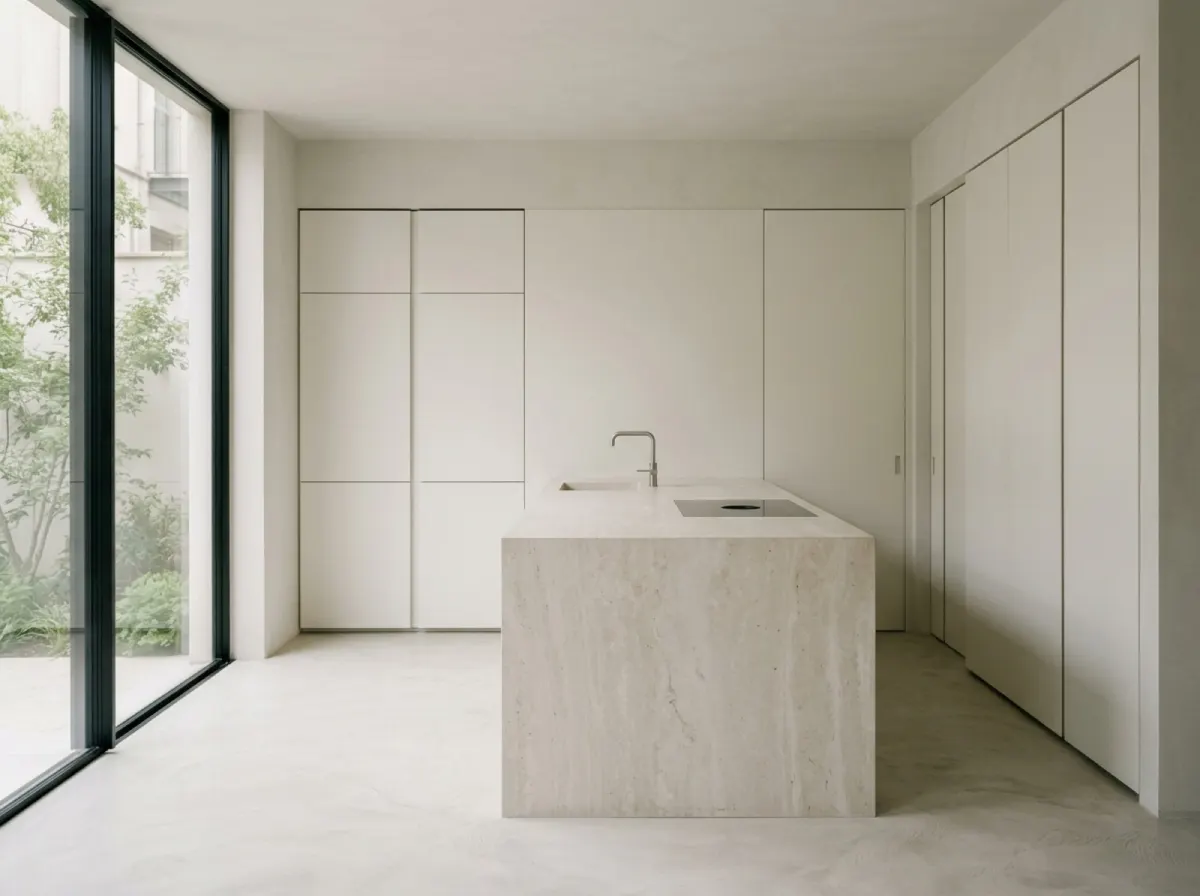
Minimalism is practically unattainable without custom furniture – only cabinetry designed for a specific interior allows you to obtain continuous planes without random gaps and visible joints. In the kitchen this means handleless fronts opening to the touch, floor-to-ceiling cabinetry and appliances fully hidden behind uniform fronts, often behind doors that retract to the side.
In the living room and bedroom minimalism is realised through smooth, handleless floor-to-ceiling wardrobes, low chests without legs and builds that blend into the wall. The key is the interior of this furniture: thoughtful drawers, organisers and shelves that mean everything has its place and nothing has to lie out in the open.
An important if discreet element is lighting. Gentle, hidden light strips in recesses and under cabinets emphasise the clean lines of the cabinetry and build mood without introducing any visible source. When designing custom furniture, it is planned right away where the appliances, sockets and cables will disappear, so that nothing disturbs the monolithic plane. For inspiration it is worth looking at the portfolio.
Minimalist style in different rooms
Minimalism follows one rule throughout the home – maximum order with a minimum of visible elements – but in each room it is realised a little differently. Most depends here on the interior of the furniture, because it decides whether you manage to keep a clean, empty plane on the outside. That is why the design of minimalist cabinetry begins not with the fronts, but with a careful analysis of what is to be hidden and where.
Kitchen
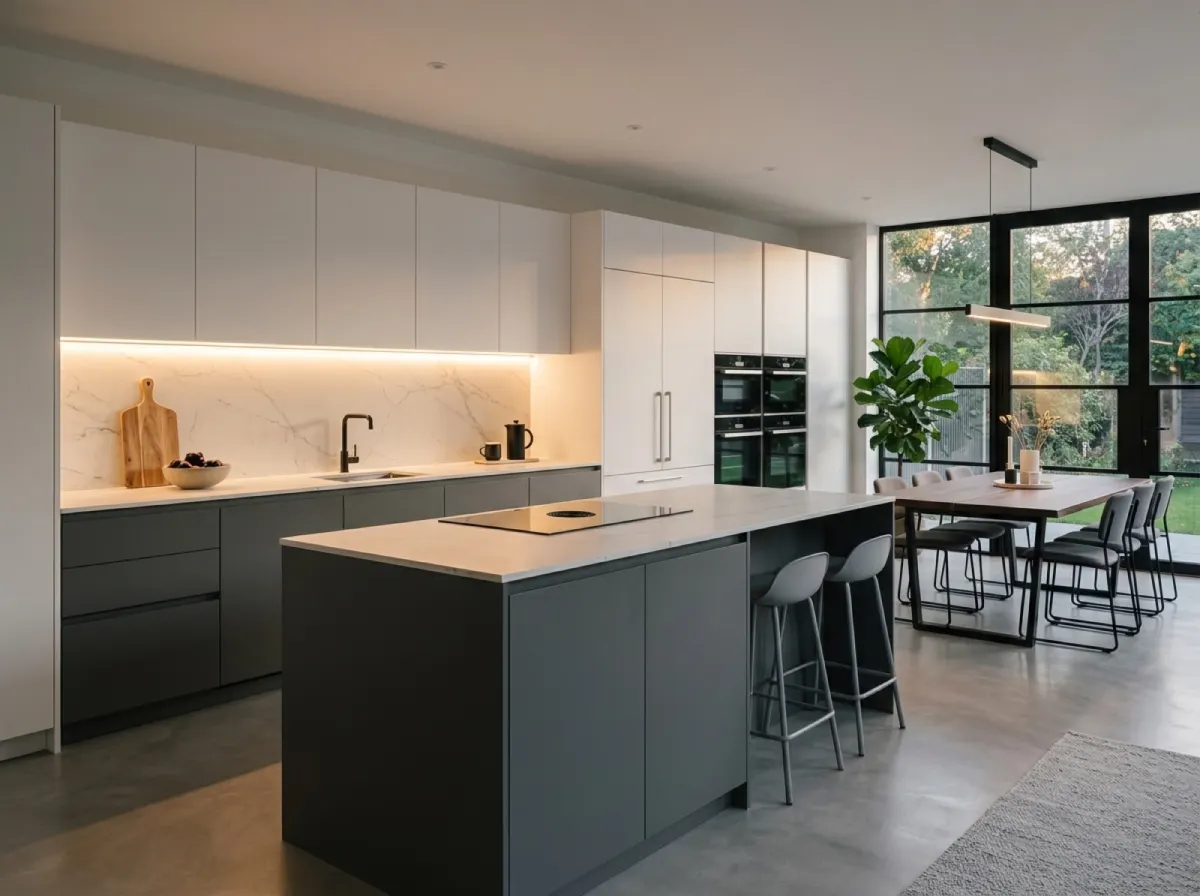
In the kitchen minimalism means full, handleless floor-to-ceiling cabinetry in which appliances, supplies and small accessories disappear. Uniform fronts without upper cabinets on show, one large, continuous worktop and an extractor integrated so as not to break the line work best. The less is visible on the outside, the more important the interior of the cabinets becomes – drawers with organisers and a thoughtful division mean nothing has to stand on the worktop, and the kitchen keeps a clean, calm look even during intensive cooking.
Living room
In the living room minimalism is realised through low, smooth builds that blend into the wall, and through giving up open shelves full of small things. The television, equipment and cables are hidden behind a uniform front, and the only accent tends to be the texture of wood or stone. As a result the room feels calm and spacious, even if it is not large, and the eye has somewhere to rest among the few, carefully chosen objects.
Bedroom and wardrobe
This is the natural environment of minimalism, because a bedroom is meant to be a space of calm anyway. Floor-to-ceiling wardrobes with handleless fronts, a well-organised wardrobe interior and soft, indirect light create surroundings in which nothing distracts. The key is that all the storage fits behind a closed plane – then minimalist calm maintains itself almost on its own, without a daily fight for order.
Bathroom and entrance zone
In the bathroom minimalism brings order to a usually chaotic space: cabinetry under the basin, a mirror with hidden lighting and uniform fronts hide cosmetics and installations. In the hallway a smooth floor-to-ceiling wardrobe with room for shoes and outerwear keeps the entrance clean despite daily traffic. This shows well that minimalism is not decoration, but a way of genuinely taming the mess in the most sensitive places in the home.
It is also worth remembering that minimalism ages well. A pure form, free of fashion, does not date as quickly as showy, trendy solutions, and the interior is refreshed by changing individual accessories rather than the whole build. This makes it a sensible choice in terms of long-term value – well-made, simple custom furniture stays current and attractive for years.
Minimalism does not have to mean giving up character either. A calm, uniform base displays a single, deliberate accent beautifully: natural stone, warm wood, one work of art or an expressive plant. Such an element gives the interior personality without breaking its quiet, and means a minimalist home is calmed rather than empty.
The most common mistakes
The first mistake is confusing minimalism with emptiness and coldness. An interior limited to white but deprived of texture, a warm material and good light looks uninhabited. The remedy is a play of textures and a single natural accent, such as wood or stone.
The second mistake is saving on the finish. This is the paradox of minimalism: the simpler the form, the more expensive the effect to achieve, because everything depends on quality. Uneven gaps, cheap gloss or weak hardware in handleless cabinetry immediately ruin the impression of cleanliness.
The third mistake is a lack of sufficient storage. Minimalism looks empty in photographs, but in reality it requires even more planned hiding places than other styles – because nothing can be left out. The fourth common problem is treating minimalism as a passing fashion and buying cheap cabinetry "as a trial". In this style it is better to do less, but really well, than a lot and carelessly.
How we do it at Grandis
We have designed and produced custom furniture for more than 15 years, in a 3 000 m² workshop. We have over 300 completed projects behind us, so we know that in minimalism everything is decided by precision – even gaps, a perfect fit of the fronts and thoughtful interiors that cannot be seen.
We start every project with a laser measurement and a 3D visualisation included in the price – before production you already see how the clean planes and divisions will play in your interior. We work with European-class materials and certified hardware, which in handleless cabinetry are a condition of durability and comfort. Installation is carried out by our in-house team, a standard project takes 2–4 weeks, and we set the price as fixed, with no annexes along the way.
In minimalism there is no ornament behind which to hide a mistake – every millimetre of a gap and every well-planned storage place counts.
Frequently asked questions
Is minimalism practical for a family with children?
Yes, provided storage is well planned. The more household members, the more important it is that every thing has its place. Handleless, easy-to-clean fronts and floor-to-ceiling cabinetry help keep order day to day.
Isn't a minimalist interior boring?
It does not have to be. Character here is built by the texture of the material, the proportions and the light, and a single natural accent – wood, stone, a plant – gives the interior warmth. Well-designed minimalism is calm, not empty.
Why is simple cabinetry sometimes more expensive than it seems?
Because the whole effect depends on the quality of execution. The absence of handles, continuous planes and perfect gaps require precise hardware and exact installation. In minimalism there is no detail behind which to hide a flaw.
How long does a custom build take?
Typically 2 to 4 weeks from approval of the project, depending on the scope. We begin the whole process with a laser measurement and a 3D design included in the price, and we set the price as fixed.