What industrial and loft style means in custom furniture: metal, raw wood and open space. Key features, materials, colours, who it suits and common mistakes.
Industrial style is the raw aesthetic of old factories: metal, brick, concrete and wood with a visible history. In custom furniture it means steel structures, strong fronts and cabinetry that brings order to an open, loft-like space.
What industrial and loft style is
Industrial style was born of pure necessity. In the mid-20th century, as factories and warehouses in big cities emptied out, artists began to inhabit these spaces – cheap, enormous and full of character. Instead of hiding the raw walls, pipes and structures, they left them on show. So the loft was born: a home in a former hall, in which industrial "ugliness" became an asset.
Over time this aesthetic moved from real factories into ordinary flats as a deliberate choice. Today industrial style no longer requires a post-industrial building – it is recreated with materials and details: brick, concrete, raw metal and wood. The loft is its most elaborate variety, based on open space, high ceilings and large windows.
The essence of the style is honesty of materials. Nothing pretends to be something else: metal is metal, concrete is concrete, and wood shows its knots and cracks. It is a raw aesthetic, but warm in its own way – full of textures, history and character. Unlike minimalism, industrial does not hide the structure but makes it the main theme of the interior.
Contemporary industrial comes in several varieties. The raw, "factory" loft relies on concrete, metal and the most open space possible. A warmer version, sometimes called rustic industrial, emphasises wood, brick and cosiness more strongly. There is also a more elegant strand in which raw materials are combined with black joinery, glass and brass, giving a refined rather than warehouse-like effect. They are all united, however, by the same principle – respect for genuine materials and a dislike of pretence. This makes the style flexible: it can be dosed from a full loft to single industrial accents in a classic flat, matching the intensity to the size of the interior and your own temperament.
Key features of industrial style
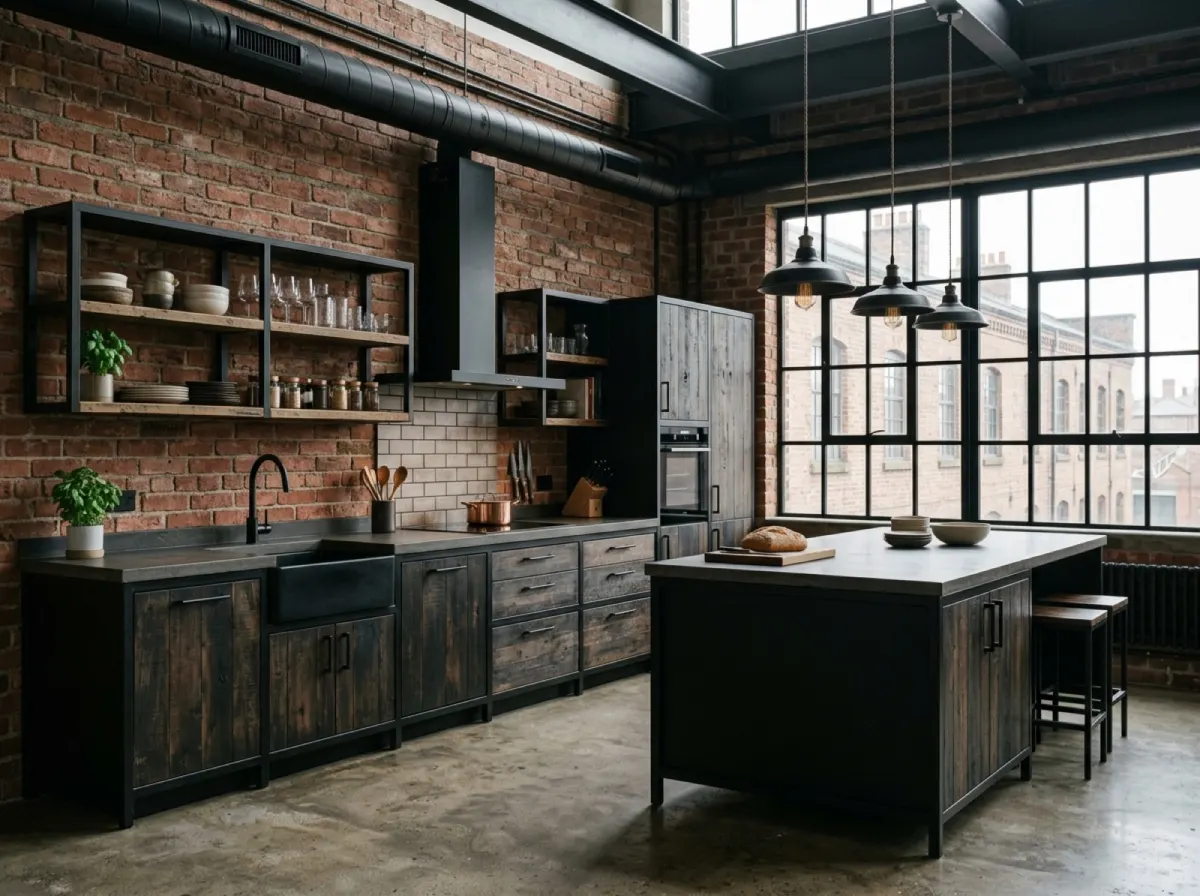
You will recognise an industrial interior by raw materials and exposed structure.
- Metal in the leading role. Black, steel structures, frames and racks.
- Raw surfaces. Brick, concrete, plaster and raw wood with a visible texture.
- Open space. High ceilings, large windows, a minimum of partition walls.
- Exposed installations. Pipes, cables and ducts as a decorative element.
- A dark, raw palette. Black, graphite, rust, the grey of concrete and the brown of wood.
- A combination of metal and wood. The hardness of steel set against the warmth of wood.
The light is also characteristic. Industrial likes large, factory windows with black muntins and expressive lamps: metal shades, spotlights, exposed bulbs. Lighting here is not discreet – it is itself often an element of the decor, emphasising the raw mood.
The second important feature is scale and openness. A loft lives on space: on the absence of walls, on height and on the view of the structure. Furniture does not fill it tightly but marks out zones – the kitchen, dining area and living room often sit side by side in one room, separated only by an island, a shelving unit or a change of flooring.
Materials and colours
The foundation is raw, durable materials. Metal in matte black or a steel finish, concrete and microcement, brick and wood with a clear, natural grain – preferably in darker, warm tones. In custom furniture it is typical to combine a steel, black frame with a wooden worktop or front, which gives the characteristic industrial contrast.
The palette is dark and muted. Black, graphite, the grey of concrete and deep browns dominate, complemented by accents of rust, copper or subdued bottle green. Strong, bright colours appear rarely – industrial relies on texture and the contrast of materials rather than on colour.
It is precisely texture that builds character here. Rough concrete, coarse brick, matte metal and wood with visible knots create a rich, multi-layered surface that enlivens even a dark interior. Leather, especially in natural, brown shades, complements this palette well and adds warmth. Brass or copper in details soften the rawness without taking away its character.
Industrial materials have one more advantage: they age well. Raw metal, solid wood or concrete gain a patina over time which in this style is an asset rather than a flaw – small traces of use add character instead of spoiling the look. It is worth remembering the practical side, though: concrete and metal surfaces are usually protected against moisture and corrosion, and wood is oiled to keep its natural appearance. This way industrial cabinetry combines a raw aesthetic with real durability and a low, if deliberate, maintenance requirement. These are materials you buy once, in the spirit of "less, but more solid".
Who industrial style suits
Industrial is a choice for people who value character, rawness and materials "with a soul". Those who do not like smoothed-out, impersonal interiors and prefer a space with an expressive mood and a history will feel at home in it.
The natural environment of the style is flats with a large volume, high ceilings and an open layout – there the loft develops its full potential. But industrial details also work well pointwise in ordinary flats, for example in the kitchen or in a work zone. It is also one of the most popular directions in commercial spaces: cafés, offices and premises, where it builds an expressive, recognisable character. You can see how it works in practice in projects for the home and for business.
How to introduce industrial style in custom furniture
Custom furniture lets you convey the industrial character while taming the raw space. In the kitchen dark fronts work well – matte black, graphite or wood with a clear grain – combined with a worktop imitating concrete or stone and with open, metal shelves. A characteristic element is cabinetry based on a black, steel frame, which references factory racks.
In the living room and day zone custom furniture helps to organise the open space: shelving and builds on metal structures mark out zones without closing them off. In lofts it is often the furniture – a tall shelving unit or kitchen cabinetry – that plays the role of a notional wall between the kitchen and the living room. Wardrobes are sometimes realised as open systems on a metal frame, with wooden shelves and leather details.
It is worth remembering that industrial does not mean giving up comfort. The raw character can be combined with modern function: hidden appliances, quiet runners and thoughtful storage concealed behind strong fronts. Lighting built into the furniture – spot light above the worktop or in shelving – goes well with expressive pendant lamps. For inspiration it is worth looking at the portfolio.
Industrial style in different rooms
Industrial develops most fully in an open space, but its elements can also be introduced one at a time, room by room. The same principle applies everywhere – honest materials and exposed structure – although in each zone it is realised with a different intensity.
Kitchen
The kitchen is the most common place where industrial appears even in an ordinary flat. Dark, matte fronts, a worktop imitating concrete or stone, open metal shelves and cabinetry on a black frame build a raw, factory character. So that the kitchen does not become cold, it is worth breaking it up with warm wood and good, spot lighting above the work zone. Appliances can be hidden behind fronts or, conversely, steel appliances can be deliberately put on show as an element of the style.
Living room and day zone
In a loft it is the furniture that organises the open space. Shelving and builds on metal structures mark out zones without closing them off, and a tall shelving unit or kitchen cabinetry often plays the role of a notional wall between the kitchen and the living room. A leather sofa, a raw table of wood and metal and expressive lamps complete the mood, while soft textiles and a rug warm the interior and improve the acoustics.
Bedroom and wardrobe
Here industrial tends to be gentler, because a bedroom should favour rest. Cabinetry combining dark metal with warm wood works well, as do open wardrobes on a steel frame with wooden shelves and a single brick or concrete wall as a background. It is worth balancing the whole with soft bedding, textiles and warm light, so that the rawness does not dominate the sleeping zone.
Work zone and commercial spaces
Industrial has reigned for years in offices, cafés and premises, because it builds an expressive, recognisable character at a small cost in decoration. In a home office metal shelving, a raw worktop and cabinetry on a black frame create an energetic, "working" environment. In a commercial space the same language gives the interior an identity and withstands intensive use well, as long as the materials are durable and well made.
It is worth remembering that industrial – despite its raw look – does not rule out comfort or durability. Modern function can hide beneath the raw aesthetic: hidden appliances, quiet runners and full storage concealed behind strong fronts. Well-made cabinetry, heavy in expression, serves for years and gains character over time instead of wearing out.
Industrial also combines well with other directions. A note of loft warms up minimalism, and combined with natural materials or vintage elements it creates individual, one-of-a-kind interiors. Thanks to an expressive yet neutral base, such mixes do not look chaotic, which gives a lot of freedom when furnishing a home.
The most common mistakes
The first mistake is overdoing the rawness. When everything is concrete, metal and dark brick, the interior becomes cold and unfriendly, closer to a warehouse than a home. The remedy is warm wood, textiles, leather and good, warm light, which soften the industrial chill.
The second mistake is treating the style as a set of gadgets. A bulb on a cable and a single brick wallpaper alone do not make a loft – industrial works when the materials are coherent and genuine in texture, rather than stuck on as decoration.
The third mistake is ignoring scale. Raw, heavy furniture and a dark palette look great in a spacious interior with a high ceiling, but in a small flat they can overwhelm it and shrink it visually. In a cramped space it is better to dose industrial pointwise. The fourth common problem is forgetting about acoustics – in an open loft with hard surfaces sound carries, so it is worth planning soft elements: fabrics, rugs, wooden cabinetry.
How we do it at Grandis
We have designed and produced custom furniture for more than 15 years, in a 3 000 m² workshop. We have over 300 completed projects behind us – including commercial and loft spaces – so we plan industrial cabinetry so that it combines a raw character with real function and durability.
We start every project with a laser measurement and a 3D visualisation included in the price – before production you already see how the metal, wood and dark fronts will play in your space. We work with European-class materials and certified hardware, so that even cabinetry that is raw in expression works quietly and reliably for years. Installation is carried out by our in-house team, a standard project takes 2–4 weeks, and we set the price as fixed, with no annexes along the way.
A good loft is not a collection of industrial gadgets, but coherent, genuine materials, warmed up with wood and light.
Frequently asked questions
Does industrial style work in a small flat?
Yes, but in moderation. In a small space heavy, dark cabinetry can overwhelm, so it is better to dose industrial pointwise – for example in the kitchen or on a single wall – and combine it with light, warm elements that add lightness.
Does a loft have to be cold and raw?
No. Raw materials are only a base – warmth is added by wood, textiles, leather and the right light. Well-designed industrial is cosy despite the concrete and metal, because it relies on a contrast of cool and warm.
Can appliances and storage be hidden in industrial style?
Yes. The raw character is easy to combine with modern function: hidden appliances, quiet runners and full storage concealed behind strong fronts. Custom furniture lets you reconcile a loft mood with everyday comfort.
How long does a custom build take?
Typically 2 to 4 weeks from approval of the project, depending on the scope. We begin the whole process with a laser measurement and a 3D design included in the price, and we set the price as fixed.
Does industrial suit a flat in an apartment block?
Yes. You do not need a post-industrial interior – the industrial character is built with materials and details: dark fronts, metal, a concrete worktop and expressive lighting. In a block it is best dosed in moderation and combined with warm wood, to keep a sense of cosiness.