Furniture trends to 2030: sustainable materials, AI design, adaptive furniture and digital product passports. What will change in Polish homes and offices?
By 2030, the furniture market in Poland will undergo a deeper transformation than in the previous two decades combined. Sustainable materials, artificial intelligence in design, adaptive furniture and digital product passports are not futuristic speculation — they are directions already shaping orders at custom furniture manufacturers today. For businesses and homeowners alike, this means one thing: it is worth knowing what is coming before the time arrives for a renovation or space upgrade.
Why 2030 Is a Turning Point for the Furniture Industry
The furniture industry is one of those sectors that changes slowly — the life cycle of a piece of furniture is typically 10 to 15 years. However, over the next five years, several independent forces will converge: EU climate requirements, the revolution in hybrid work models, rising costs per square metre in cities and the wider adoption of AI tools in interior design.
According to industry estimates from 2024, the global furniture market will exceed 700 billion dollars in value by the end of the decade. Poland, as one of the three largest furniture producers in Europe, will be directly affected by this trend — both on the production side and in consumer demand.
From our experience across 300 or more commercial projects and 800 or more residential fit-outs, questions about durability, sustainability and future-readiness already arise today — increasingly before budget discussions have even begun.
Trend 1: Certified Materials and Carbon Footprint
European regulations on product carbon footprints — including CBAM and the expanded Ecodesign directive — will begin to affect furniture producers in a tangible way before 2028. This means that chipboards and HPL laminates without emissions documentation will simply fall out of the supply chains of reputable designers and construction companies.
Grandis Trade uses exclusively E1-class boards and HPL laminates from European manufacturers holding formaldehyde emissions certificates and PEFC or FSC documentation. This is not marketing — it is a foundation that allows us to issue ESG documents for corporate clients right now.
What to expect by 2030? A universal requirement for a digital material passport — a document containing the history of raw materials, carbon footprint and end-of-life instructions for the product. Manufacturers who implement this documentation earlier will gain a significant competitive advantage in B2B procurement.
Trend 2: AI in Design — What Really Changes
Artificial intelligence tools entered interior design not as a curiosity but as a genuine acceleration of the process. In 2024, several leading CAD/CAM platforms integrated language models with rendering engines — the result is that a conceptual sketch is produced in minutes, not hours.
However, AI does not replace on-site measurements, knowledge of material properties or installation experience. From our practice, AI tools work best as a visualisation assistant — clients make colour and layout decisions faster when they see a realistic render before signing any contract.
By 2030, AI configurators for office spaces will likely be fed data from IoT sensors — real movement patterns and zone utilisation within a given office. This means furniture designed around specific user behaviour rather than an imagined open-space model. To see how we design commercial spaces today, visit our commercial portfolio.
Trend 3: Hybrid Space — Home and Office Combined
The hybrid work model is not going to reverse by 2030. According to office market research from 2024, over 60 per cent of knowledge workers in Poland work remotely at least two days per week. This creates lasting pressure on residential design to incorporate professional functionality.
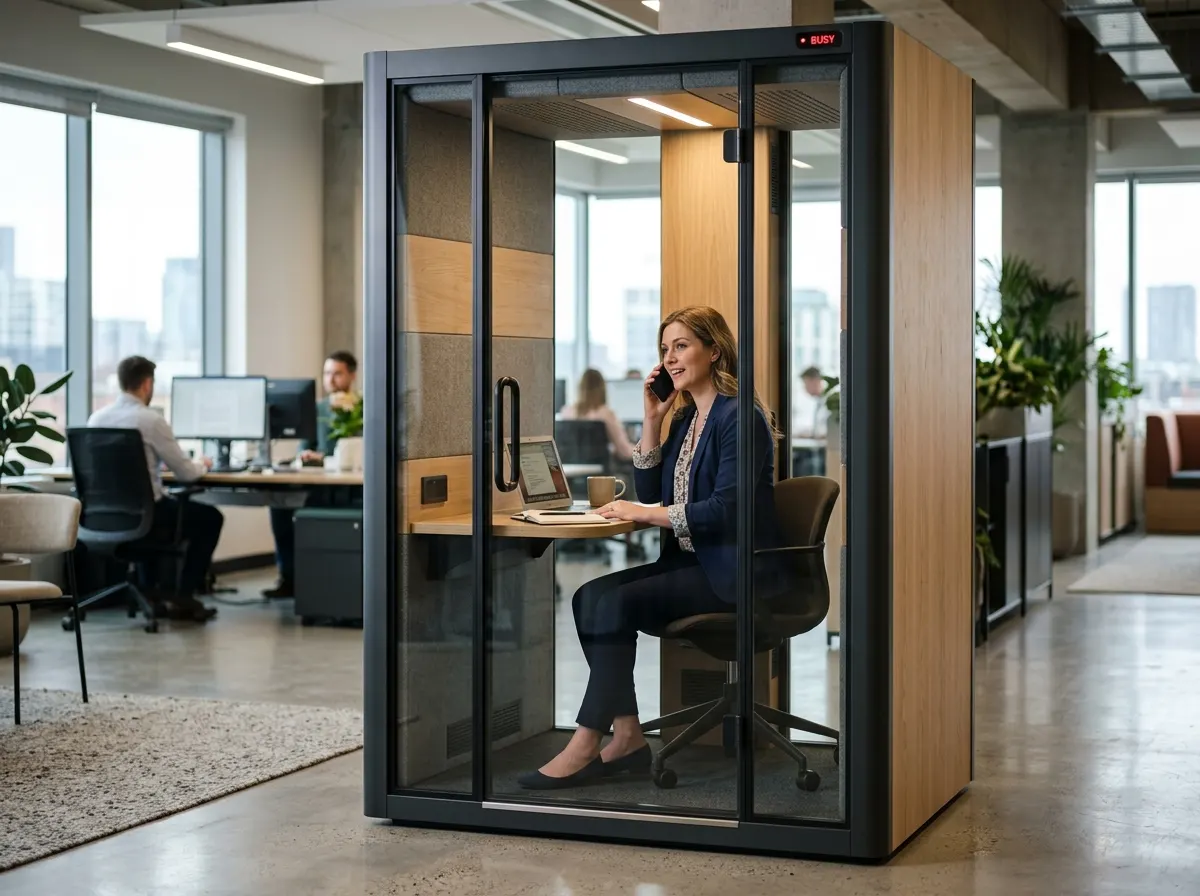
Custom-made furniture addresses this challenge more precisely than catalogue products: a wardrobe-office that opens and closes with a single movement, built-in acoustic solutions, a retractable work surface — these are solutions that allow a normal domestic rhythm in a 50 to 70 square metre apartment without the permanent visual presence of an office in the living room.
When designing residential spaces across Warsaw — from Mokotów to Białołęka — we notice that questions about home working zones come up in 7 out of every 10 consultations. Details about residential built-in furniture can be found on our furniture for home page.
Trend 4: Digital Passports and the Circular Economy
The concept of the Digital Product Passport (DPP) has been written into the EU's Ecodesign for Sustainable Products Regulation (ESPR), which comes into force in stages from 2026. For the furniture industry, this means every product should carry a unique identifier containing data on raw materials, the production process and the method of recycling.
The practical implications for buyers: when planning a renovation of an office or home, it is worth asking suppliers for material documentation now. Companies that cannot provide it will be excluded from public and corporate tenders after 2027 to 2028.
Grandis Trade maintains full material documentation for every project — technical data sheets, attestations and certificates are available to the client after project completion. This is a standard that is becoming a market requirement.
Trend 5: Modularity and Longevity Instead of Seasonal Furniture
The fast furniture culture — cheap pieces bought and discarded every few years — is meeting growing resistance: rising disposal costs, environmental awareness and simply higher real estate prices, which push owners to plan interiors for the longer term.
Custom furniture has a structural advantage here: it is designed for specific dimensions and users, made from more durable materials than mass production and — with the right joinery technology — allows disassembly and reassembly when moving home.
A 3-year warranty for residential clients and up to 5 years for business clients with a service agreement are not arbitrary figures — they reflect the actual durability of the materials and hardware we use.
Comparison of Approaches to Furnishing Spaces Towards 2030
| Criterion | Catalogue furniture (mass-produced) | Custom furniture (Grandis Trade) |
|---|---|---|
| Fit to floor plan | Limited — standard sizes only | Full — designed to exact dimensions |
| ESG documentation / certificates | Often absent or generic | Technical data sheets, E1 attestations, certificates |
| Digital product passport | Rare by 2030 | Full project documentation available to client |
| Durability and warranty | 2 years statutory minimum | 3 years B2C, up to 5 years B2B with contract |
| Modularity / disassembly | Usually none | Possible with appropriate design |
| Lead time | Off the shelf or short delivery | 3D design included, installation in approx. 3 weeks |
| Alignment with 2030 trends | Requires product replacement | Designed for a 10 to 15-year perspective |
How to Prepare Office Space for 2030 Requirements — a Step-by-Step List
- Audit your current materials — do you have material documentation and attestations? Without this information, future ESG certifications will be more difficult.
- Assess your work model — how many days per week are employees in the office? The answer determines the number of workstations and the type of acoustic treatment needed.
- Plan your zones — focus zones, collaboration zones and wellbeing zones are not a fashion; they are a functional response to different modes of working.
- Choose certified materials — E1-class boards, HPL laminates with emissions documentation, fabrics with abrasion and UV resistance attestations.
- Build in flexibility — modular furniture, partition wall systems that can be repositioned and extended, electrical supply under every table.
- Ask for a 3D design — do not accept a fit-out without a visualisation. A 3D design catches mistakes before production and installation.
- Check the warranty and after-sales service — the difference between 2 and 5 years of warranty on office furniture used by dozens of employees daily is measurable in financial terms.
If you want to start by finding out what is possible in your space, complete the business client brief — we will get back to you promptly to arrange a free site visit.
Case Study: R&D Office Modernisation in Mokotów, Warsaw
Client: a technology company with a research and development department, approximately 420 square metres of office space in Mokotów, around 65 employees. The problem: the office was designed in a full-time attendance model in 2015 — a classic open space with rows of identical desks, no quiet zones and no informal meeting areas.
After moving to a hybrid model with three days in the office, the space turned out to be simultaneously too large and too cramped: many empty desks, no room for video calls or focused work.
The Grandis Trade solution: redesigning the space into three functional zones without demolition — acoustic built-in units dividing the open space into sectors, focus niches with integrated lighting and sound dampening, a new entry zone layout with furniture for daily stand-ups. All in materials consistent with the client's existing visual identity.
Result: after four months of use, the client reported an increase in declared employee satisfaction with the space and a reduction in noise complaints. The project was completed within the agreed budget and schedule — a fixed price locked in the contract means no surprises. More similar projects can be found in the B2B portfolio.
What Market Changes Mean for Homeowners
Individual clients may be less directly affected by market trends than businesses, but the impact is real — with every decision about a custom kitchen, bedroom built-in or fitted wardrobe.
The key takeaway: custom furniture designed today should be ready for 2030 — meaning made from certified materials, sized to include a remote work zone, with hardware and mechanisms that will withstand intensive use for the next decade.
A free measurement with travel to the client, 3D design included in the project price and a fixed price in the contract — this is how Grandis Trade makes the decision about custom furniture financially predictable from the start. Check our residential portfolio or complete the short quiz to help define the scope and budget of your project.
We serve clients from all districts of Warsaw — if you live in Mokotów, Wola, Wilanów, Ursynów, Praga, Białołęka or Bemowo — visit your district page to see projects completed nearby.
The Polish Furniture Market in 2030 — a Producer's Perspective
The Polish furniture industry is in a good starting position today: a developed production base, access to European raw materials and a growing culture of interior design. The challenges for the next five years are adaptation to ESG requirements, digitalisation of processes and maintaining profitability amid rising energy and labour costs.
For clients — both businesses and private individuals — this means growing value in partners who combine design expertise with transparent material documentation and genuine warranties. Not every producer will survive this transformation in its current form.
According to industry estimates from the 2024 furniture market report, the custom furniture segment is growing faster than the catalogue furniture market — which is logical when we consider increasing urbanisation, shrinking floor areas and the need to make precise use of every centimetre of space.
Frequently Asked Questions
Will custom furniture become more expensive after 2027 because of ESG regulations?
The increase in costs for fully certified materials is real but gradual. Producers who already use certified boards and hardware will not experience sudden price changes. Buyers who currently choose the cheapest options without documentation may face replacement costs in a few years — which ultimately proves more expensive.
What is a furniture digital passport and can one be obtained now?
A Digital Product Passport (DPP) is a collection of documents confirming the origin of materials, carbon footprint and end-of-life instructions. Grandis Trade provides clients with material documentation after every project — technical data sheets, attestations and certificates. The full DPP as defined by the ESPR regulation will be required in stages from 2026.
How will AI design affect the cost and lead time of custom furniture?
AI tools shorten the concept visualisation phase — clients see proposals faster and make decisions more quickly. The actual production and installation time remains similar, as it depends on CNC processes and installation teams rather than the design phase. At Grandis Trade, the 3D design is included in the project price.
How should a hybrid office be planned to avoid a full redesign in three years?
The key is modularity and built-in flexibility: partition walls that can be repositioned, electrical supply in the floor or columns, acoustic furniture that can be moved around. Avoid rigid built-ins that permanently define the layout — instead, choose systems that allow reconfiguration without breaking walls.
Does Grandis Trade work on projects outside Warsaw?
Our primary area of activity is Warsaw and the surrounding area within approximately 50 kilometres — here we have our own installation teams and can arrange a free measurement within 48 hours. Projects in other cities are carried out selectively, with individual pricing for transport and installation. Get in touch via the brief or call +48 453 436 171.
What colour and material trends will dominate furniture by 2030?
From what we observe, clients increasingly choose warm wood tones — oak and walnut — over cool greys, natural textures such as stone, concrete and wood instead of smooth gloss finishes, and muted colour palettes combined with a single bold accent zone. There is a clear move away from uniformly light interiors towards material layering and warmth.
Can custom furniture be taken when moving home?
Yes, with the right design — furniture mounted on wall brackets or modular systems can be disassembled and reinstalled in a new location. Fixed built-ins such as floor-to-ceiling kitchen units are harder to remove without damage. It is worth discussing this aspect at the design stage if you are planning a move within the next few years.
How quickly can a measurement and consultation be arranged?
We carry out free measurements within 48 hours of an enquiry anywhere in Warsaw. Contact us via the home quiz form, the business brief or by calling +48 453 436 171 — we will be in touch within the working day.
Article last updated: 20 May 2026