Acoustic pods offer mobile sound isolation up to 40 dB for open-plan offices — no renovation, no dust, fully customizable. See how Grandis Trade delivers quiet zones.
Noise in open-plan offices is one of the most frequently cited problems by employees and managers alike. Mobile acoustic pods — freestanding, self-contained sound-insulated cabins — make it possible to create a quiet zone without a full renovation, without dust, and without weeks of downtime. Installation takes a single working day, and if the company moves offices, the pods move with it. Below we explain what acoustic pods are, how to select them, and when custom-made solutions are worth the investment over off-the-shelf catalogue products.
Why Office Noise Is a Business Problem, Not Just a Comfort Issue
Workplace market research consistently ranks noise among the leading causes of reduced concentration and employee dissatisfaction in open-plan environments. Studies show that workers can lose dozens of productive minutes per day simply recovering their focus after each acoustic interruption. For companies with sales teams, contact centres, and R&D departments — where confidentiality and deep concentration are critical — this is not a comfort issue. It is a measurable productivity loss.
Based on our experience across 300+ commercial projects, acoustic complaints are most common in precisely those departments. Traditional glass partition walls reduce noise partially, but they do not eliminate it — and they require landlord approval or a building permit to install permanently.
Acoustic pods solve this problem differently. They are freestanding, do not touch the building structure, and require no permit. If the lease ends, the company takes the pods with it — protecting the full investment in acoustic infrastructure.
What Exactly Is an Acoustic Pod?
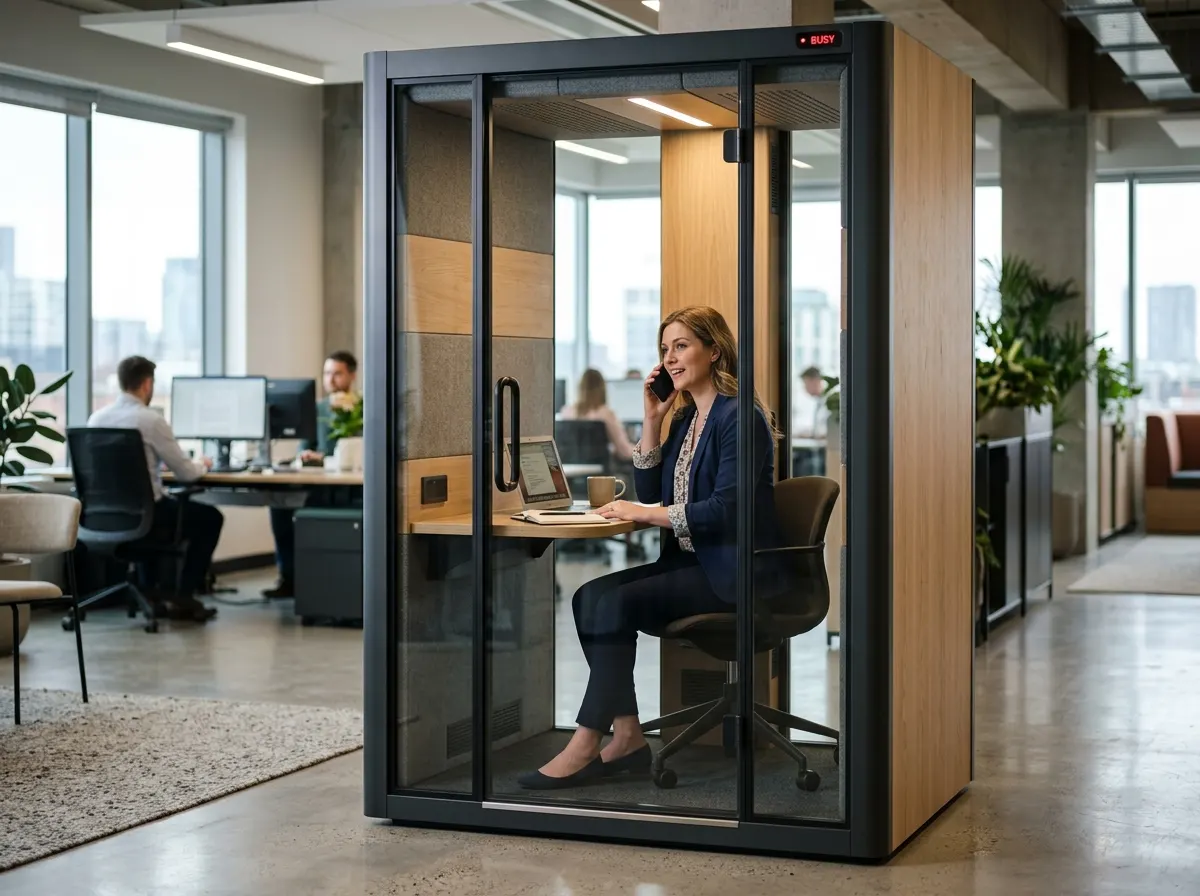
An acoustic pod is a freestanding structure — typically shaped as a booth, box, or enclosed cabin — fitted with sound-absorbing and sound-insulating materials. Inside you will find mechanical ventilation, LED lighting, and electrical sockets with USB ports. The exterior shell is made from upholstered panels, technical felt, or boards with an acoustic core.
The main configurations available on the market are:
- Single-person Focus Pod: designed for individual work, phone calls, and video conferences. Footprint 1.2 to 2 m².
- Two-to-four-person Meeting Pod: for short team discussions without booking a conference room. Capacity 2–4 people, footprint 3–6 m².
- Phone Booth: compact single-person standing unit for quick calls — minimal footprint, no seat.
- Open Acoustic Nook: semi-open module with side and ceiling panels, reducing noise without fully enclosing the space.
Sound insulation in standard pods falls between 30 and 42 dB, reducing a loud open-office background to library-level quiet. Premium configurations exceed 40 dB attenuation.
Installation Without Renovation: How It Works in Practice
The primary advantage of pods is that they require no structural work. The cabins stand on the floor — often on integrated transport castors — and connect only to a standard electrical socket. Ventilation is built in and does not require connection to the building's central HVAC system.
A typical deployment timeline looks like this:
- Analysis of the office floor plan and identification of pod locations (usually 1–2 days).
- Order or production of the pod (for custom pieces: several weeks of manufacturing).
- Delivery and positioning on site — one working day.
- Electrical connection, ventilation and lighting commissioning.
- Optional staff briefing on usage guidelines.
When the office relocates, pods are efficiently dismantled and reassembled in the new space. The company does not lose its acoustic investment, as so often happens with partition walls or ceiling adaptations that cannot be taken along.
Comparison of Acoustic Solutions for the Office
Before committing to a specific solution, it helps to compare available options by cost, flexibility, and effectiveness.
| Solution | Insulation (dB) | Installation time | Renovation required | Mobility | Approximate cost |
|---|---|---|---|---|---|
| Acoustic Pod | 30–42 dB | 1 working day | No | Yes (on castors) | High (one-time investment) |
| Glass partition walls | 28–35 dB | 3–7 days | Yes (anchoring) | Limited | Medium |
| Freestanding upholstered panels | 5–15 dB | A few hours | No | Yes | Low–Medium |
| Ceiling acoustic treatment | 10–20 dB | 5–14 days | Yes | No | Medium |
| Built conference room | 40–55 dB | 3–8 weeks | Yes (structural) | No | Very high |
The comparison shows clearly that pods represent the best balance between insulation performance and flexibility. They are not a substitute for a large conference room serving 20 people, but for 1–4 person quiet zones in a leased office, they are the optimal choice.
Key Parameters When Selecting Acoustic Pods
When purchasing or ordering custom pods, check the following specifications:
- RW rating (weighted sound reduction index): minimum RW 30 dB for a Focus Pod, RW 35+ for a Meeting Pod.
- Ventilation: minimum 35–50 m³/h per person — pods without adequate ventilation become stuffy within minutes.
- Lighting: colour temperature 3000–4000 K, minimum 500 lux for screen-based work.
- Power and USB: at least 2 standard 230 V sockets plus 2 USB-C ports per workstation.
- Material certifications: fire resistance class B-s1,d0 or better; internal panels with sound absorption coefficient α ≥ 0.8.
- Maintainability: upholstered panels that can be removed for cleaning or replacement.
- Environmental certifications: recycled content, VOC emission certificate (E1 class or CARB standard).
If you plan to order pods matched to your corporate visual identity — RAL colour for the exterior shell, branded upholstery, logo panel — custom manufacturing makes more sense than a catalogue product. In that case, custom office furniture and acoustic solutions from Grandis Trade allow you to synchronise pods with the rest of your office fit-out.
Off-the-Shelf vs. Custom Pods: When Does Customisation Pay Off?
The market offers pods ranging from entry-level to high-specification products. Catalogue items are available quickly — often from stock — but come in fixed dimensions, a limited colour palette, and a standard internal layout.
Custom-made pods make sense when:
- The office has non-standard dimensions or a layout where standard cabins would block evacuation routes.
- The company is rolling out a cohesive office design with specific upholstery materials and colours.
- Integration with a room management system (RMS) or building management system (BMS) is required.
- Technical documentation and certification are needed for a BREEAM or LEED audit.
- The pods will serve an additional function — such as a mini recording studio or UX research booth.
From our experience with Warsaw office projects: clients who ordered office furniture and pods together achieved a visually consistent result and saved on coordinating two separate suppliers. More examples are available in the Grandis Trade commercial portfolio.
Case Study: Acoustic Zones for a Technology Company in the Mokotow District
Client profile: an IT sector company, R&D department, office in Mokotow, Warsaw — 620 m² floor area, open-plan layout with 60 workstations. The problem: intensive video conferencing activity was clashing with deep-focus work across the rest of the team. The landlord had not given consent for permanent partition walls.
The solution: Grandis Trade designed and produced 4 single-person Focus Pods and 2 four-person Meeting Pods. The exterior finish was matched to the company's visual identity palette — dark graphite with a copper accent. Inside: LED panels at 4000 K, ventilation at 45 m³/h per person, two 230 V sockets and two USB-C ports per station. All internal panels used E1 chipboard laminated with technical felt at an absorption coefficient of α = 0.9.
The project ran three weeks from contract signing to completed installation. The pods were positioned without any structural intervention — connected only to standard electrical sockets. According to client feedback, the number of unplanned interruptions caused by noise during the working day fell noticeably, and employees now routinely use the pods for calls instead of leaving the building. When the company eventually relocates, the pods travel with them at no reinstatement cost.
Details of similar commercial projects are available in our B2B portfolio. If you are planning a similar fit-out, start by submitting a project brief — we will respond promptly.
How to Implement Pods in Your Office: Step-by-Step Checklist
A practical checklist for the person responsible for the rollout:
- Diagnose the acoustic problem: gather feedback from the team, identify the noisiest zones, and pinpoint where people most often seek silence.
- Measure the available floor space: account for evacuation routes (minimum 1.2 m width) and health and safety clearance requirements between workstations.
- Check the lease conditions: ask the landlord about permissible floor loading (pods weigh 200–800 kg) and whether additional electrical connections are allowed.
- Decide: off-the-shelf or custom: if you have non-standard colour, spatial, or certification requirements — order custom.
- Determine the number of pods: industry guidelines for office design recommend approximately 1 Focus Pod per 8–10 workstations in an open-plan area.
- Plan the electrical connections: verify that sockets are within 2–3 metres of each planned pod location, or arrange for a cable channel in the raised floor.
- Introduce a booking system: even a simple sign-up board or a phone app prevents individual staff members from occupying a pod for hours at a time.
- Set usage rules: maximum continuous occupancy time (e.g. 45–60 minutes), cleaning responsibilities, and a process for reporting faults.
Acoustics and ESG: Do Pods Fit the Sustainable Office Agenda?
A growing number of companies include employee well-being under the Social pillar of ESG reporting. Workplace quality — including acoustic comfort — directly affects staff retention and absenteeism figures. According to labour market research, improving the office environment, acoustics included, correlates with lower staff turnover, which has a direct financial impact.
On the materials side, look for pods built with certified components: E1 chipboard with limited formaldehyde emission, technical felt upholstery made from recycled PET, powder-coat finishes free of volatile organic compounds. For custom orders, you can request full material documentation to support your ESG report.
Grandis Trade uses E1-class chipboard from certified European manufacturers and finishing materials with emission certifications — allowing our corporate clients to reference our projects in their environmental reports. Details are available for companies ordering through our B2B channel — describe your requirements in the project brief form.
Frequently Asked Questions About Acoustic Pods
Does an acoustic pod require a building permit?
No — provided it is freestanding and not permanently attached to any part of the building (walls, ceiling, or floor). Standard pods rest on their own legs or castors and connect only to a standard electrical socket, without modifying the building's services. It is worth checking your lease agreement, however, since some landlords require written approval for items above a certain weight threshold.
How effective is 30–40 dB insulation in practice?
A 30 dB reduction means that a loud office conversation (around 65 dB) is heard from outside the pod at approximately 35 dB — the level of a quiet conversation or whisper. In practice, a colleague sitting 2 metres from the pod hears speech as an unintelligible murmur rather than distinct words. For the confidentiality requirements of sales calls, HR discussions, and legal consultations, this level is sufficient in the vast majority of cases.
How much does a custom pod cost compared to a catalogue product?
A catalogue product from a manufacturer typically ranges from several thousand to tens of thousands of Polish zloty per unit, depending on size and specification. A custom pod can cost a similar amount or more — depending on material specification, dimensions, and degree of customisation. The benefit is full control over appearance, dimensions, internal layout, and technical documentation. When ordering several pods at once, the per-unit cost of custom production is often comparable to catalogue pricing.
How long does production of custom acoustic pods take?
With a standard specification, typically three weeks from design sign-off to delivery and installation. Complex technical requirements or large dimensions may extend the timeline — a precise schedule is agreed individually at the briefing stage. Our B2B projects are covered by a fixed price in the contract, with no change orders during production.
Can pods be easily relocated when the company moves offices?
Yes — this is one of their principal advantages over fixed solutions. Pods are dismantled without specialist tools or with a basic toolkit. Most models have integrated transport castors or can be flat-packed for moving. During an office relocation, pods are classified as movable equipment rather than permanent fixtures, which means no reinstatement charges at the end of the lease.
Does Grandis Trade produce acoustic pods for small offices and coworking spaces?
Yes — we carry out projects for large corporations with 300+ workstations as well as for small offices, agencies, and coworking spaces. The minimum order is a single pod. For clients fitting out an entire office — from furniture through to acoustic zones — we offer comprehensive design and production services. Full details in our B2B offering or via the project brief form.
What maintenance do acoustic pods require?
Felt or textile upholstery needs weekly vacuuming in heavily used offices and periodic cleaning with a specialist fabric treatment product. Upholstered panels in quality pods are removable and can be sent to a professional dry cleaner. Glass or hard plastic exterior surfaces clean with standard household products. Ventilation filtration: replace the filter every 6–12 months depending on the manufacturer's specification.
Are acoustic pods suitable for schools, medical practices, and other public spaces?
Yes — pods are used well beyond corporate offices. In medical practices they serve as booths for confidential consultations. In libraries they provide video-conferencing spaces. In universities they function as individual study or online-examination rooms. Technical requirements are broadly similar, but in public spaces particular attention should be paid to fire resistance certifications, as the regulatory standard is stricter than for private offices.
Article last updated: 20 May 2026