How CAD/CAM software eliminates production errors, cuts lead time by half and reduces material waste. A practical guide for investors and business owners.
CAD/CAM systems have fundamentally changed the furniture production chain: a design created on screen travels directly to a CNC machining centre without intermediate hand-drawn plans, manual dimension transcription or the risk of error at every handoff. For custom furniture manufacturers this means cutting the time from approved sketch to finished part by up to half, near-complete elimination of dimensional rejects and full repeatability across every production run. In this article we explain how the technology works, what it delivers to the end client and why Grandis Trade has embedded digital workflow as a standard — not an optional upgrade.
What CAD/CAM Means in Furniture Manufacturing
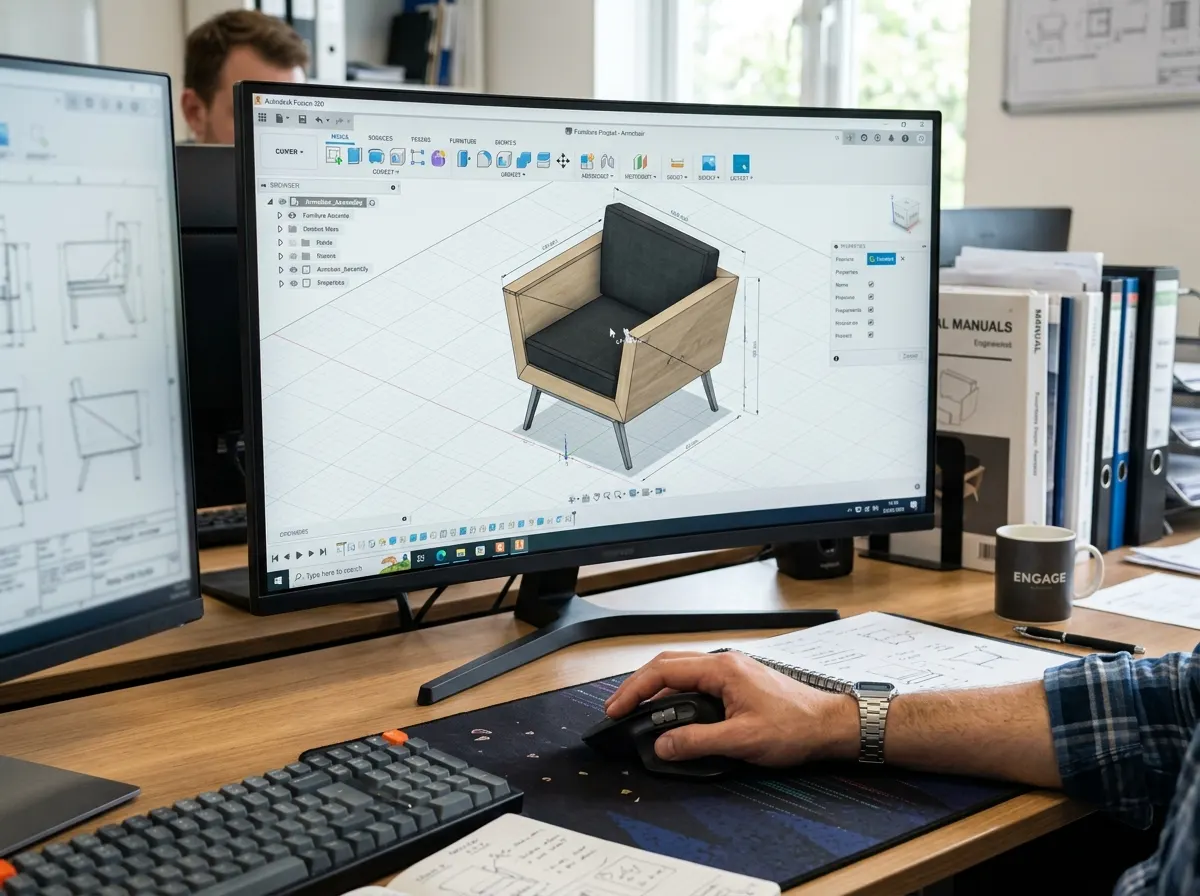
CAD (Computer-Aided Design) is the three-dimensional design environment: the furniture designer builds a full model with exact dimensions, material selection, hardware placement and veneer colour visualisation. CAM (Computer-Aided Manufacturing) is the next stage — the software converts the 3D model into precise machine instructions for CNC equipment: milling paths, drilling positions, cutting parameters and edge-banding sequences.
In practice both layers operate within a single environment. The designer draws a wardrobe; the system automatically generates a parts list, optimises the cutting layout on sheet material (known as nesting) and exports machine-ready files to start production. The human approves — the machine executes. The risk of a transcription error when copying dimensions drops to zero.
Based on Grandis Trade experience across more than 800 residential projects and over 300 commercial installations, implementing digital workflow has the strongest impact on two measurable outcomes: the number of warranty claims due to incorrect dimensions (virtually eliminated) and production lead time (reduced by 30–50% compared with the traditional technical-drawing model).
The Digital Workflow: Step by Step
- On-site measurement and documentation: a Grandis Trade technician visits the location, measures the space to 1 mm accuracy and enters data directly into the design system. Measurement is free of charge and scheduled at an agreed time.
- 3D modelling: the designer builds the full furniture model in CAD software — including materials, colours, hardware and internal layout. The client sees a complete photorealistic visualisation before making any decision.
- Review and approval: the client reviews the 3D model, requests any adjustments and confirms. Changes at this stage cost nothing — no material has been cut yet.
- CAM file generation: approved models are passed to the CAM module, which automatically produces cutting plans, bills of materials and machine instructions.
- Nesting optimisation: the algorithm arranges parts on sheet panels to minimise waste — industry estimates put material savings at 8–15% compared with manual cutting layout.
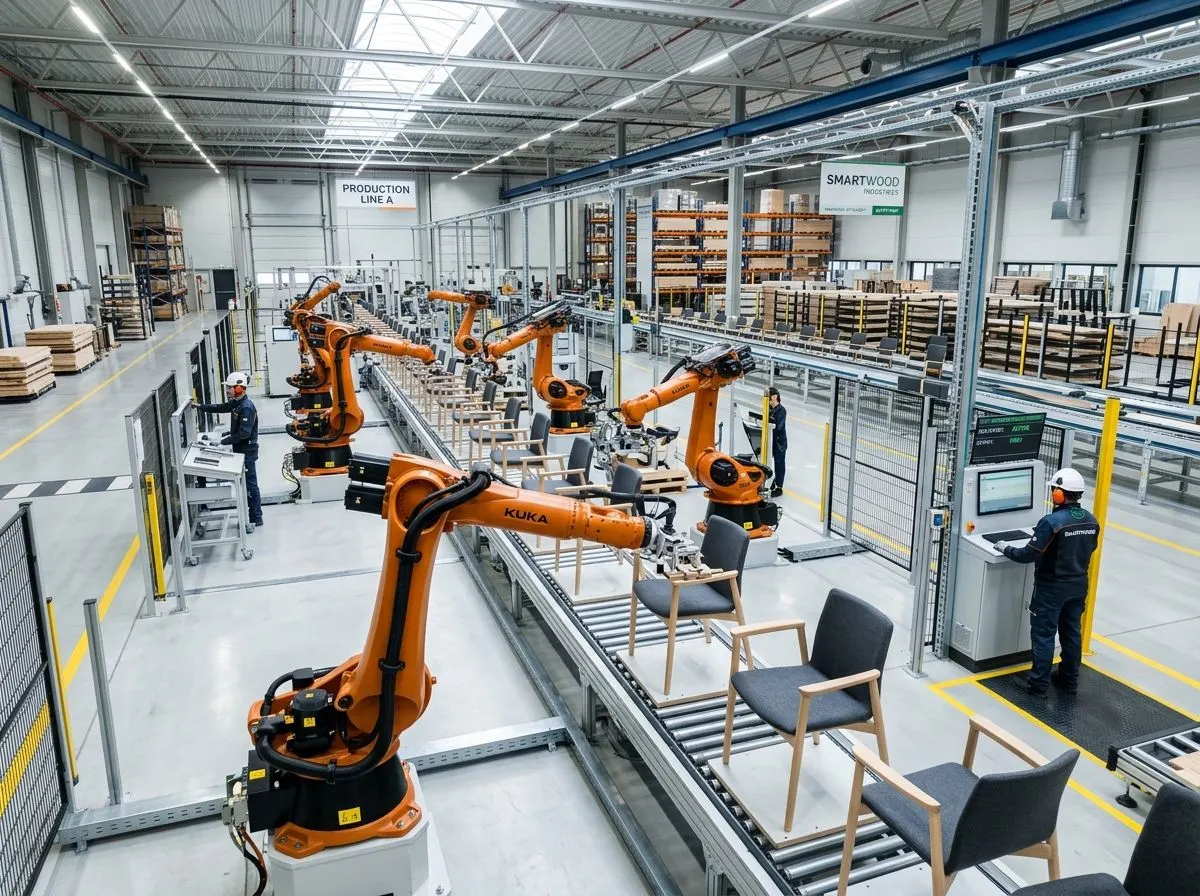
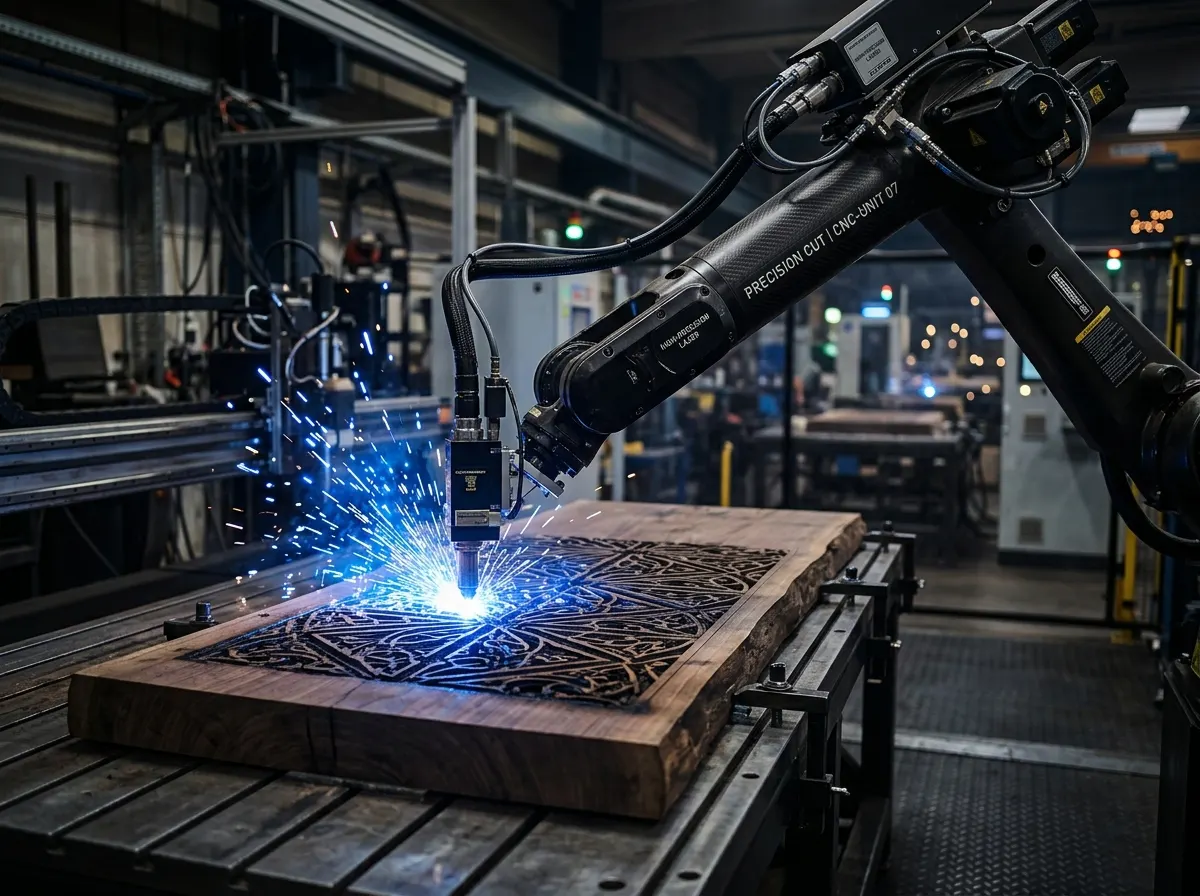
- CNC production: files are loaded onto the machining centre. Milling cutters, drill heads and edge-banders follow the digital instructions — dimensions are reproduced to 0.1 mm tolerance on every part.
- Quality control: finished parts are measured and verified against the system parts list. Any deviation beyond tolerance prevents the batch from proceeding to assembly.
- Installation and handover: complete sets go to the client. Installation is faster because every component fits — no edge trimming or on-site hole correction required.
0.1 mm Accuracy: What It Means in Practice
Furniture made from hand drawings or simplified CAD carries a typical tolerance of 1–2 mm per part. In a wardrobe with 40 panels this accumulates into visible gaps, uneven door fronts and difficulty mounting adjustable hinges within tight clearance ranges.
A digital CNC workflow reduces tolerance to 0.1 mm per part. In practice this means: door fronts sit perfectly flush, drawers with soft-close mechanisms install without forced adjustment and carcass constructions are perfectly square after first assembly.
For residential clients this translates to comfort and aesthetics. For B2B clients it is a concrete financial argument: installation is 20–30% faster, the risk of damage during assembly is lower and there are no on-site correction costs. If you are planning an office or commercial fit-out, the details of our B2B delivery are on the business clients page.
3D Visualisation: Make Your Decision Before the First Cut
One of the greatest benefits of a CAD/CAM system for end clients is the ability to see the complete product in 3D — with veneer details, handles, LED lighting and true-to-scale proportions within the actual room — before a single panel has been cut.
In practice the Grandis Trade designer works in software that generates a photorealistic render in near-real time. The client can compare board colour options, adjust shelf layouts, test different door systems and immediately see the result. A change on screen takes a few minutes — a change after the panel has been cut costs material, time and money.
Our experience shows that clients who have access to a 3D visualisation before approval raise far fewer issues after installation. This reduces the number of additional service visits and shortens the overall project timeline. Completed projects can be viewed in our portfolio.
Traditional Workflow vs. CAD/CAM: Side-by-Side Comparison
| Stage | Traditional model | CAD/CAM at Grandis Trade |
|---|---|---|
| Transferring dimensions to production | Manual drawing, hand-copied figures | Automatic export from 3D model |
| Risk of dimensional error | High — human error at every handoff | Minimal — 0.1 mm CNC tolerance |
| Pre-production visualisation | 2D sketch or none at all | Full 3D render with veneers and hardware |
| Sheet material cutting plan | Manual or simplified | Automated nesting, 8–15% material saving |
| Lead time from approval to production | Several working days | Reduced by 30–50% |
| Project modifications | Requires a new drawing | Change one parameter in the model, all files update automatically |
| Series repeatability (B2B) | Depends on the individual worker | Identical for every unit, production file archived |
| Cost of a production error | Borne by the client or manufacturer | Error detected at digital stage, before any cutting |
ROI of CAD/CAM Technology: When and for Whom
For a furniture manufacturer, a full CAD/CAM implementation with CNC machining centres requires investment in the hundreds of thousands of zloty. Industry estimates and the experience of SME furniture businesses suggest the return on this investment occurs within 12–24 months when production volume exceeds a defined order threshold.
For the end client — residential or commercial — ROI is calculated differently. You pay for the product, not the technology. But you gain: fewer warranty claims, shorter lead times, full 3D visualisation before production starts and a guarantee of repeatability. At Grandis Trade the CAD/CAM standard is built into the price of every order — whether it is a kitchen in Mokotów or a fit-out for an office network.
Reducing material waste through nesting is an additional benefit. Premium European laminate boards and HPL panels represent a significant share of project costs. Optimising cutting layout by even 10% on a large B2B project can mean savings equivalent to one full day of installation labour.
CAD/CAM in Commercial Projects: Scale and Repeatability
In B2B projects — retail chains, corporate offices, hotels and HoReCa venues — repeatability is the decisive factor. If a network has 30 locations, each fitted with identical service counters, shelving units and display installations, CAD/CAM guarantees that unit number 30 is identical to unit number one. The production file is archived and can be re-run months or years later.
In the traditional model every order means a new drawing, new risk of error and new verification time. In a digital workflow: an approved file equals guaranteed repeatability. This is the argument Grandis Trade makes in every conversation about network projects. A fixed contract price with no amendments is possible precisely because production costs are predictable — the technology removes the variables.
If you manage a portfolio of locations and need a manufacturer capable of serial delivery with guaranteed consistency, submit a B2B brief and our sales team will contact you during the working day.
Case Study: Flexible Office Network, Warsaw
Client: an operator of flexible offices with locations across Warsaw, including the city centre and Wola district. The order covered a new 420 m² location — open-plan workstations, meeting rooms, a reception area and a kitchen zone.
The challenge: the client had a hard opening deadline tied to a lease agreement and could not afford delays or post-installation corrections. At a previous location a different supplier had missed dimensions, doubling the installation time against plan.
The Grandis Trade solution: full digitisation of the project from measurement through to CNC output. The technician completed the on-site survey in a single working day; the designer generated 3D models of every component; the client approved all visualisations and materials before production started. CAM files went to the machining centre. Nesting optimised material usage across all E1-class laminated panels, reducing waste to a minimum. Every part was produced to 0.1 mm tolerance and installation ran on schedule.
Result: the location opened on time. The client filed zero dimensional warranty claims. The project was archived digitally — when the next location was fitted out, design time was significantly shorter because it was based on already-approved documentation. The project is available in the commercial portfolio section.
Materials and Hardware in the Digital Design Process
A CAD/CAM system is not separate from material knowledge — quite the opposite. The design software contains material libraries with real technical parameters for each board type: thickness, weight, moisture resistance and formaldehyde emission class. The designer selects a U2/E1 chipboard with CARB certification and the system automatically calculates cutting tolerances, selects milling parameters and flags a warning if the chosen material is unsuitable for the intended application — for example, a wet zone without adequate moisture treatment.
Hardware integration works the same way. Quality drawer runner and hinge mechanisms have their exact mounting hole coordinates, minimum edge distances and adjustment ranges stored in the system. The designer picks a hardware system from the library — the software automatically places all mounting holes on the CNC drilling list. No drilling errors, no misaligned hinge.
The result for the client: furniture made from premium European boards, fitted with high-quality soft-close systems, designed and produced entirely through a digital process — this is a quality guarantee at every stage of production.
Grandis Trade: Technology as Standard, Not an Add-On
At Grandis Trade digital CAD/CAM workflow is not a premium option reserved for selected projects. It is the standard applied to every order — from a bedroom wardrobe in Ursynów to a full hotel fit-out. We have over 12 years of experience, 3,000 m² of in-house production capacity in Warsaw and more than 1,100 completed projects in total.
The warranty for residential clients is 3 years; for B2B clients with a service agreement it extends to 5 years. Measurement is free, the 3D project is included in the production price and standard installation is completed within 3 weeks of project approval. The fixed contract price means no surprises at handover.
We serve residential clients across Warsaw — Mokotów, Wola, Wilanów, Ursynów, Praga, Białołęka, Bemowo, Żoliborz. We have dedicated pages with local project references for specific districts: Mokotów, Wola, Wilanów, Ursynów. Business clients are welcome to visit the business section or contact us directly via the B2B brief form.
Residential clients can start with a short online quiz that helps us understand your needs before the first conversation. Phone: +48 453 436 171, WhatsApp: wa.me/48453436171.
Frequently Asked Questions
Can I see a 3D visualisation before signing the contract?
Yes. The 3D project is included in the price of every order. Before the contract is signed and production starts, the client always receives a complete furniture visualisation — with veneers, hardware, colour and proportions matched to the room. Changes at the design stage are free of charge.
How accurate are the dimensions of digitally produced furniture?
CNC machining from CAM files achieves 0.1 mm tolerance per part. In practice: door fronts sit perfectly flush, drawers with soft-close systems install without forced adjustment, and carcass constructions match the room dimensions to the millimetre.
Does CAD/CAM technology affect the price of furniture?
Digital workflow is a Grandis Trade standard included in every quote — there is no separate line item for 3D design or nesting optimisation. The technology indirectly reduces cost: less material waste, fewer post-installation corrections and a shorter lead time all contribute to a better value-for-money ratio.
How long does the process take from measurement to installation?
The standard timeline from approved design to installation is approximately 3 weeks. On-site measurement takes place free of charge at an agreed time. Implementing digital workflow has cut delivery times by 30–50% compared with the traditional technical-drawing model.
Are production files archived? Can I reorder identical furniture a year later?
Yes. All approved projects and CAM files are archived. A B2B client can reorder an exact repeat of a previous installation without redesigning from scratch. This is particularly important for networks with multiple locations.
Does CAD/CAM work for small projects such as a single bedroom wardrobe?
Yes — and this is one of the reasons Grandis Trade applies the technology as a standard across all orders. Even a simple freestanding wardrobe is modelled digitally and its components produced with full CNC precision. A residential client receives the same production quality as a large B2B customer.
What materials are available in the design library?
The design software contains libraries of chipboard and HPL panels from premium European manufacturers — classified by moisture resistance, E1/CARB emission class and available veneer colours. The designer selects the material to match the requirements of the specific space: wet zones, office furniture or display installations.
How do I contact Grandis Trade about a project with digital workflow?
The fastest way is by phone at +48 453 436 171 or via WhatsApp. Residential clients can fill in the online quiz; business clients can submit a B2B brief. Our team responds promptly during the working day.
Article last updated: 20 May 2026