Japandi blends Japanese wabi-sabi with Scandinavian hygge. Discover why this warm minimalism dominates Polish interiors in 2026 and how to bring it into your home.
Japandi is one of the few interior design trends that has not faded after a year of popularity — by 2026 it has become a standard of residential design in Poland. The fusion of Japanese wabi-sabi with Nordic hygge produces interiors that are simultaneously calm, functional and warm. This is not about fashion — it is a philosophy of living with space that Polish consumers have begun to embrace deliberately.
What Exactly Is Japandi Style?
Japandi (from Japan + Scandinavia) is an aesthetic hybrid born from the observation that two seemingly distant design traditions share a common core: respect for material, restraint of form, and the conviction that the environment shapes human wellbeing.
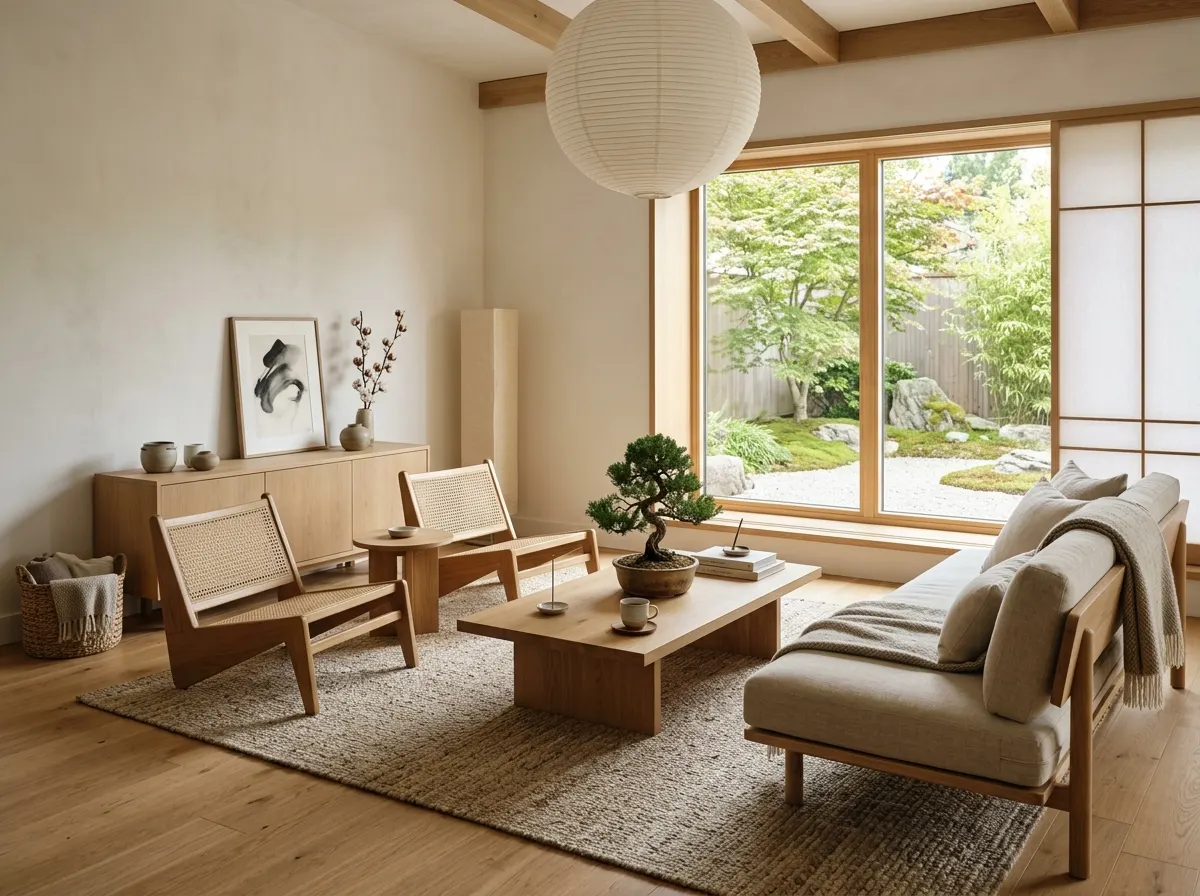
Japanese wabi-sabi teaches acceptance of imperfection and the passage of time — hence Japandi is dominated by natural textures, the irregularity of wood grain, and matte surfaces. Scandinavian hygge brings warmth: soft textiles, warm shades of white and beige, lighting that creates atmosphere. Together they produce a style in which austere form does not exclude comfort.
According to industry estimates from 2024, searches for Japandi furniture and interiors grew by more than 60% in Poland over two years. Developers of new residential projects in Warsaw increasingly incorporate Japandi aesthetics at the standard fit-out stage, confirming the style's transition from niche to mainstream.
Why Minimalism Became Warm — and Why Now
For years minimalism was associated with coldness — white walls, grey concrete, no ornament. Visually correct, but difficult to live with day after day. Japandi answered this problem by introducing warmth through material and colour rather than through objects.
The pandemic and the shift to working from home played a decisive role. When a flat stopped being merely a place to sleep and became simultaneously an office, a dining room, a relaxation zone and a classroom for children, Polish consumers began investing seriously in interiors that genuinely support wellbeing. Japandi offers exactly that answer: fewer things, but each one of good quality and considered purpose.
Our specialists at Grandis Trade observe that clients increasingly stop saying "I want something modern" and start saying "I want this to look just as good in ten years as it does today." Japandi is precisely that investment — a style that does not age with the seasons.
Key Characteristics of Japandi Furniture
Japandi's recognisability rests on a set of consistently applied design principles that determine both the aesthetics and the functionality of each piece.
- Low profiles: sofas, beds and coffee tables on low bases or hidden legs — visually raising the ceiling and opening up the space.
- Natural materials: light oak, ash, bamboo, linen, organic cotton, matte stone — plastic and gloss are excluded.
- Neutral colour palette: off-white, beige, greige, deep moss green, terracotta as small accents — no loud contrasts.
- Functional ornament: furniture decorates through the quality of its joints and the texture of its material, not through decorative elements. Visible wooden frames, pronounced grain, matte handles.
- Hidden storage: cabinets and built-ins conceal clutter behind handle-free fronts (push-to-open) or handles that match the front colour.
- Lighting as a design element: warm directional LED (2700–3000 K), shelf and niche underlighting, pendant lamps with fabric shades.
- Avoiding strict symmetry: asymmetric compositions and odd-numbered groupings create an organic feel and a sense of a lived-in interior.
Japandi in the Reality of Polish Apartments
Polish flats have their own specific characteristics: often irregular layouts, sloping walls on top floors, small bathrooms, open-plan kitchen-living rooms. Japandi proved exceptionally well suited to these spaces — its principles work regardless of square footage.
In apartments up to 50 m², low built-in furniture visually enlarges the space and hidden storage eliminates visual chaos. In larger homes, Japandi helps avoid the trap of furnishing for the sake of furnishing — every element has its justification and its place.
If you are looking for made-to-measure furniture for your Warsaw apartment, explore our home project portfolio. We design kitchen cabinetry, wardrobes and walk-in closets that fit the Japandi aesthetic without requiring a complete renovation order.
It is also worth browsing the gallery of our home projects — you can see how Japandi principles translate into custom furniture across different apartment layouts, from studios to 120 m² apartments.
Japandi Compared with Other Popular Styles in 2026
Clients often ask how Japandi differs from other similarly described directions. The table below clarifies the key distinctions.
| Feature | Japandi | Classic Minimalism | Boho | Quiet Luxury |
|---|---|---|---|---|
| Colour palette | Off-white, beige, moss green | White, grey, black | Terracotta, indigo, deep red | Cream, camel, dark navy |
| Dominant materials | Wood, linen, bamboo, matte stone | Concrete, glass, brushed metal | Rattan, patterned textiles, macrame | Natural leather, marble, brass |
| Furniture form | Low, organic, asymmetric | Geometric, symmetric | Loose, layered, eclectic | Classic, proportional, understated |
| Decor | Minimal — texture instead of ornament | Zero decoration | Abundant — rugs, cushions, plants | Sparse but exclusive |
| Warmth of interior | High | Low | Very high | Medium |
| Ease of execution | Medium — requires careful material selection | Easy — fewer elements | Difficult — many layers | Difficult — high material cost |
| Visual longevity | Very high — timeless | High | Low — tires quickly | Very high |
How to Plan Japandi Custom Furniture — 7 Steps
Bringing Japandi aesthetics into a home does not require a full renovation or replacing every piece of furniture. The process can unfold in stages, starting with the key focal points of the space.
- Start with one room: the kitchen or bedroom are the best entry points — changes there have the most perceptible impact on daily comfort.
- Choose a leading material: decide whether light oak, matte stone or linen will dominate — material consistency is the essence of Japandi.
- Limit the palette to three colours maximum: a neutral base (off-white or beige) plus a wood accent plus one accent colour (moss, terracotta or charcoal).
- Plan storage before choosing decor: furniture without adequate storage is a recipe for the clutter that will destroy a Japandi aesthetic within a week.
- Think low: if ceiling height allows, choose furniture with a lower profile — this immediately changes the proportions of the room.
- Lighting last, but plan the wiring first: shelf and niche underlighting requires installation before the cabinetry is built, not after.
- Test textures, not only colours: when ordering custom furniture, ask for material samples and touch them — in Japandi, tactile quality is as important as appearance.
Japandi Furniture and Durability — Investment or Trend?
This question comes up in almost every conversation with a client planning a kitchen or wardrobe in this style. The answer is straightforward: Japandi is one of the few aesthetics with a built-in mechanism for ageing gracefully.
Natural wood develops a patina over the years, creating individual character. Matte HPL surfaces with class U2 certification retain their colour and mechanical resistance through a decade of regular use. Class E1 chipboard from European manufacturers meets strict formaldehyde emission standards — significant for bedroom and children's room furniture.
Our experience across 800+ home projects shows that clients who chose a Japandi aesthetic five years ago return to us not because the style bored them, but because they want to extend the built-in furniture to another room. That is the best possible recommendation.
We offer a three-year warranty on all B2C furniture, and we select materials to make sure the warranty never needs to be used. The measurement visit is free, the 3D design is included in the price, and installation takes place within the standard three-week window from project approval.
Case Study: Japandi Kitchen and Wardrobe in Mokotow
Client: a couple with two children, 78 m² apartment in a new-build development in Mokotow, Warsaw. The developer handed over the flat in shell condition with white walls and radiators — no furniture whatsoever.
Challenge: an open-plan living room with kitchen (35 m²) and a bedroom with walk-in wardrobe (18 m²). The client wanted Japandi aesthetics, but without a "museum-like" quality — the home was to feel like a space to live in, not to photograph for Instagram.
Grandis Trade solution: kitchen cabinetry with natural light oak fronts on the upper units and matte cream lower cabinets. Sandstone-effect laminate worktop — scratch-resistant and warm in texture. Push-to-open upper cabinets with no visible handles; a central kitchen island serving simultaneously as a cooking space, breakfast bar and homework desk. In the bedroom: a flush walk-in wardrobe behind sliding doors with no visible frame from the outside.
Result: the client received a visually coherent space in which wooden elements and matte surfaces create a Japandi atmosphere without any decorative element beyond a single plant on the kitchen worktop. The client's comment after three months of use: "I feel as though this interior calms us down when we come home after work." That is precisely the point.
If you live in Mokotow or nearby districts, explore our made-to-measure furniture offer for Mokotow. We also carry out projects in Wola, Wilanow, Ursynow and throughout Warsaw.
Grandis Trade and Japandi — How We Work
At Grandis Trade we do not impose styles — we listen to what the client wants to achieve in their space. But Japandi is a style we are particularly glad to realise, because its principles align with our own approach to quality: less, but better.
We use U2/E1-class laminate boards from European manufacturers, premium hardware systems with soft-close drawer runners and hinges with three-axis adjustment. Everything is priced individually — the price is fixed in the contract, with no addenda and no surprises later.
We serve both private clients and investors, developers and commercial property owners. If you are interested in Japandi furniture for your home, complete the short quiz — we will respond promptly with a preliminary estimate. For B2B projects we recommend the project brief form with a description of the investment.
Frequently Asked Questions about Japandi Style
How does Japandi differ from standard minimalism?
Japandi adds material and emotional warmth to minimalism. Classic minimalism is often cold and sterile — Japandi preserves simplicity of form but introduces warm wood, natural textiles and organic shapes that make the space pleasant to live in, not merely to look at.
Does Japandi work in small apartments?
Exceptionally well. The low profile of furniture visually raises the ceiling, hidden storage eliminates visual chaos, and the neutral palette does not "eat" the space. In studios of 25–35 m², Japandi built-in furniture can radically transform the perceived size of the room.
What wood is typical for Japandi?
Above all, light natural or bleached oak, ash and bamboo. Visible grain and natural texture are essential — the goal is not an imitation of wood in a glossy laminate, but a material that looks and, where possible, feels like real wood. In custom furniture this is achieved with natural veneers or premium-class wood-effect laminate boards.
Is Japandi expensive to execute?
Japandi does not require expensive materials — it requires well-chosen materials. Consistency and quality of execution matter more than the unit cost of each element. Our experience across 800+ projects shows that the budget for a Japandi kitchen is comparable to a kitchen in any other style — the difference is made by the design, not the price list.
How long does a custom Japandi furniture project take?
From first contact to installation, the standard timeline is approximately three to five weeks: measurement and 3D design, approval, production and installation. The measurement visit is free, and the 3D design is included in the order price.
Does Japandi work in offices and commercial premises?
Yes, particularly in wellness offices and spaces where visual calm and a good working atmosphere matter. We see growing interest in Japandi aesthetics in yoga studios, therapy practices, boutique hotels and premium cafe chains. Grandis Trade carries out commercial projects — learn more about our B2B offer.
How do you choose lighting for a Japandi interior?
The foundation is warm LED (2700–3000 K), several lighting zones on dimmers, and accent points — shelf underlighting, niche lighting, kitchen island pendants. We avoid cold white light and fluorescent sources. Pendant lamps are chosen in natural materials — rattan, linen, rice paper — as a decorative element that does not conflict with Japandi minimalism.
Does Grandis Trade carry out projects outside Warsaw?
We focus primarily on Warsaw and the surrounding area within 50 km. We work in all districts of the capital — from Mokotow through Wola to Bialoleka and Bemowo. For projects outside that range, transport and installation costs are quoted individually — write to us or complete the form and we will be in touch promptly.
Article last updated: 20 May 2026